Guide for Aviation Medical ExaminersVersion 09/30/2026
Section 17
ITEM 47. Psychiatric
43 pagesPages 385–388
(Updated 10/14/2021)
CHECK EACH ITEM IN APPROPRIATE COLUMN Normal Abnormal
Psychiatric (Appearance, behavior, mood, communication, and memory)
I. Code of Federal Regulations
All Classes: 14 CFR 67.107(a)(b)(c), 67.207(a)(b)(c), and 67.307(a)(b)(c)
No established medical history or clinical diagnosis of any of the following:
A personality disorder that is severe enough to have repeatedly manifested itself by overt acts.
A psychosis. As used in this section, "psychosis" refers to a mental disorder in which:
The individual has manifested delusions, hallucinations, grossly bizarre or disorganized behavior, or other commonly accepted symptoms of this condition; or
(ii) The individual may reasonably be expected to manifest delusions, hallucinations, grossly bizarre or disorganized behavior, or other commonly accepted symptoms of this condition.
A bipolar disorder.
Substance dependence, except where there is established clinical evidence, satisfactory to the Federal Air Surgeon, of recovery, including sustained total abstinence from the substance(s) for not less than the preceding 2 years. As used in this section -
"Substance" includes: alcohol; other sedatives and hypnotics; anxiolytics; opioids; central nervous system stimulants such as cocaine, amphetamines, and similarly acting sympathomimetics; hallucinogens; phencyclidine or similarly acting arylcyclohexylamines; cannabis; inhalants; and other psychoactive drugs and chemicals; and
(ii) "Substance dependence" means a condition in which a person is dependent on a substance, other than tobacco or ordinary xanthine-containing (e.g., caffeine) beverages, as evidenced by-
(A) Increased tolerance
(B) Manifestation of withdrawal symptoms;
(C) Impaired control of use; or (D) Continued use despite damage to physical health or impairment of social, personal, or occupational functioning.
No substance abuse within the preceding 2 years defined as:
Use of a substance in a situation in which that use was physically hazardous, if there has been at any other time an instance of the use of a substance also in a situation in which that use was physically hazardous;
A verified positive drug test result, an alcohol test result of 0.04 or greater alcohol concentration, or a refusal to submit to a drug or alcohol test required by the U.S. Department of Transportation or an agency of the U.S. Department of Transportation; or
Misuse of a substance that the Federal Air Surgeon, based on case history and appropriate, qualified medical judgment relating to the substance involved, finds-
Makes the person unable to safely perform the duties or exercise the privileges of the airman certificate applied for or held; or
(ii) May reasonably be expected, for the maximum duration of the airman medical certificate applied for or held, to make the person unable to perform those duties or exercise those privileges.
No other personality disorder, neurosis, or other mental condition that the Federal Air Surgeon, based on the case history and appropriate, qualified medical judgment relating to the condition involved, finds-
Makes the person unable to safely perform the duties or exercise the privileges of the airman certificate applied for or held; or
May reasonably be expected, for the maximum duration of the airman Medical certificate applied for or held, to make the person unable to perform those duties or exercise those privileges.
(Also see Items 18.m.,18.n., and 18.p.)
II. Examination Techniques
The FAA does not expect the AME to perform a formal psychiatric examination. However, the AME should form a general impression of the emotional stability and mental state of the applicant. There is a need for discretion in the AME/applicant relationship consonant with the FAA's aviation safety mission and the concerns of all applicants regarding disclosure to a public agency of sensitive information that may not be pertinent to aviation safety. AMEs must be sensitive to this need while, at the same time, collect what is necessary for a certification decision. When a question arises, the Federal Air Surgeon encourages AMES first to check this Guide for Aviation Medical Examiners and other FAA informational documents. If the question remains unresolved, the AMEs should seek advice from a RFS or the Manager of the AMCD.
Review of the applicant's history as provided on the application form may alert the AME to gather further important factual information. Information about the applicant may be found in items related to age, pilot time, and class of certificate for which applied. Information about the present occupation and employer also may be helpful. If any psychotropic drugs are or have been used, follow-up questions are appropriate. Previous medical denials or aircraft accidents may be related to psychiatric problems.
Psychiatric information can be derived from the individual items in medical history (Item 18). Any affirmative answers to Item 18.m., “Mental disorders of any sort; depression, anxiety, etc.," or Item 18.p., "Suicide attempt," are significant. Any disclosure of current or previous drug or alcohol problems requires further clarification. A record of traffic violations may reflect certain personality problems or indicate an alcohol problem. Affirmative answers related to rejection by military service or a military medical discharge require elaboration. Reporting symptoms such as headaches or dizziness, or even heart or stomach trouble, may reflect a history of anxiety rather than a primary medical problem in these areas. Sometimes, the information applicants give about their previous diagnoses is incorrect, either because the applicant is unsure of the correct information or because the applicant chooses to minimize past difficulties. If there was a hospital admission for any emotionally related problem, it will be necessary to obtain the entire record.
Valuable information can be derived from the casual conversation that occurs during the physical examination. Some of this conversation will reveal information about the family, the job, and special interests. Even some personal troubles may be revealed at this time. The AME’s questions should not be stilted or follow a regular pattern; instead, they should be a natural extension of the AME's curiosity about the person being examined. Information about the motivation for medical certification and interest in flying may be revealing. A formal Mental Status Examination is unnecessary. For example, it is not necessary to ask about time, place, or person to discover whether the applicant is oriented. Information about the flow of associations, mood, and memory, is generally available from the usual interactions during the examination. Indication of cognitive problems may become apparent during the examination. Such problems with concentration, attention, or confusion during the examination or slower, vague responses should be noted and may be cause for deferral.
The AME should make observations about the following specific elements and should note on the form any gross or notable deviations from normal:
Appearance (abnormal if dirty, disheveled, odoriferous, or unkempt);
Behavior (abnormal if uncooperative, bizarre, or inexplicable);
Mood (abnormal if excessively angry, sad, euphoric, or labile);
Communication (abnormal if incomprehensible, does not answer questions directly);
Memory (abnormal if unable to recall recent events); and
Cognition (abnormal if unable to engage in abstract thought, or if delusional or hallucinating).
Significant observations during this part of the medical examination should be recorded in Item 60, of the application form. The AME, upon identifying any significant problems, should defer issuance of the medical certificate and report findings to the FAA. This could be accomplished by contacting a RFS or the Manager of the AMCD.
III. Aerospace Medical Disposition
Drug and alcohol conditions are found in Substances of Dependence/Abuse.
A. General Considerations. It must be pointed out that considerations for safety, which in the "mental" area are related to a compromise of judgment and emotional control or to diminished mental capacity with loss of behavioral control, are not the same as concerns for emotional health in everyday life. Some problems may have only a slight impact on an individual's overall capacities and the quality of life but may nevertheless have a great impact on safety. Conversely, many emotional problems that are of therapeutic and clinical concern have no impact on safety.
B. Denials. The FAA has concluded that certain psychiatric conditions are such that their presence or a past history of their presence is sufficient to suggest a significant potential threat to aviation safety. It is, therefore, incumbent upon the AME to be aware of any indications of these conditions currently or in the past, and to deny or defer issuance of the medical certificate to an applicant who has a history of these conditions. An applicant who has a current diagnosis or history of these conditions may request the FAA to grant an Authorization under the special issuance section of part 67 (14 CFR 67.401) and, based upon individual considerations, the FAA may grant such an issuance.
All applicants with any of the following conditions must be denied or deferred:
Attention deficit/hyperactivity, bipolar disorder, personality disorder, psychosis, substance abuse, substance dependence, suicide attempt.
In some instances, the following conditions may also warrant denial or deferral:
Adjustment disorder; bereavement; dysthymic; or minor depression; use of psychotropic medications for smoking cessation
NOTE: The use of a psychotropic drug is disqualifying for aeromedical certification purposes. This includes all sedatives, tranquilizers, antipsychotic drugs, antidepressant drugs (including SSRI’s - see exceptions below), analeptics, anxiolytics, and hallucinogens. The AME should defer issuance and forward the medical records to the AMCD.
C. Use of Antidepressant Medications. (Updated 05/31/2023) The FAA has determined that applicants requesting first, second, or third-class medical certificates while being treated with one of several specific antidepressant medications may be considered. The Authorization decision is made on a case-by-case basis. The AME may not issue.
If the applicant opts to discontinue use of the SSRI, the AME must notate in Block 60, Comments on History and Findings, on FAA Form 8500-8 and defer issuance. To reapply for regular issuance, the applicant must be off the SSRI for a minimum of 60 days with a favorable report from the treating physician indicating stable mood and no aeromedically significant side effects.
See SSRI Decision Path I
Therapy, Psychotherapy and Counseling Information: Pilots / ATCS
(Updated 5/27/2026) Mental Health Counseling: A Guide for Pilots and Air Traffic Control Specialists (ATCS) Maintaining mental health is crucial for ensuring both safety and operational performance. Counseling or therapy is encouraged when medically appropriate.
If you are undergoing or contemplating counseling, see the following resources:
See your therapist, counselor, physician, or provider and get healthy.
If questions see, “Therapy, Psychotherapy, and Counseling FAQs for Pilots and ATCS.”
Bring your therapist a copy of “Information for Psychotherapists Treating Pilots and ATCS.”
Therapy, Psychotherapy, and Counseling FAQs for Pilots and ATCS
(Updated 05/27/2026)
Can pilots and ATCS seek therapy?
Yes. Many aviators benefit from therapy at different points in their careers. All are encouraged to seek help early before conditions get severe. Therapy may help with:
Anxiety or mood symptoms
Life transitions
Personal development and resilience
Relationship challenges
Stress management
Where do I start?
Pilot Peer Support Programs, your AME, or your primary care provider may recommend someone. When seeking a therapist/counselor, make sure they are licensed with at least a Master’s degree. On your first visit, you should provide a copy of “Information for Psychotherapists Treating Pilots and ATCS” to the provider.
Does it matter if my therapist uses the word "psychotherapy," or "counseling"?
No. For FAA purposes, the terms therapy, psychotherapy, and counseling are equivalent.
Must I report to the FAA immediately?
Pilots: No. You are not obliged to report until your next application for medical certificate. ATCS: Air Traffic controllers must abide by FAA Order 3930.3C 9.e.1-5 and should consult with the appropriate flight surgeon prior to performing any safety-related duties.
Must I ground myself immediately?
It depends. Pilots must abide by 14 CFR § 61.53, which states in part, “no person may act as pilot in command, or in any other capacity as a required pilot flight crewmember, while that person knows or has reason to know of any medical condition that would make the person unable to meet the requirements for the medical certificate necessary for the pilot operation.” If the severity of the symptoms is enough to impair concentration, memory, emotional stability, judgment, decision-making, alertness, etc., then yes. Otherwise, no.
What are some examples of the need to immediately self-ground?
Some examples include:
Losing control with alcohol or the use of mind-altering substances, including misusing medications
Major depression (low mood combined with difficulty doing day-to-day activities, loss of interest or pleasure in most normal activities, sleep disturbances, etc.)
Delusions, hallucinations, or paranoia
Severe anxiety or panic attacks
Rapid mood changes, difficulty regulating your emotions, or increased sensitivity to stressors or conflicts
Suicidal thoughts
Any other mental state or situation that significantly distracts from appropriate in-cockpit functioning, controlling, awareness, or communication Self-grounding is a professional safety decision and is also viewed as a sign of good insight.
Can pilots and ATCS continue therapy while maintaining FAA medical certification or clearance? Yes. Psychotherapy is compatible with both an unrestricted medical certificate and special issuance/special consideration. Many pilots and ATCS continue therapy or have the option of resuming therapy while on special issuance or special consideration.
Does speaking with a therapist automatically create a diagnosis?
No. The therapist should make an assessment, which may or may not be a diagnosis. Again, you should provide a copy of ‘Information for Psychotherapists Treating Pilots and ATCS’ to the provider to assist in this determination.
What if the therapist does make a diagnosis?
Depending on the diagnosis, the current severity of symptoms, and associated risk factors, the AME may issue the medical certificate without further FAA review or defer to the FAA. The FAA will then review the case and issue or consider special issuance or special consideration.
Can I use medication as well as therapy?
Yes. For many conditions, medication with therapy is more effective than either alone. Aviators taking medication will have additional requirements. See “Use of Antidepressant Medications.”
What must be reported to the FAA regarding therapy or counseling?
All visits to licensed healthcare providers, including psychotherapists and counselors, must be reported on the MedXPress application. Educational counseling and religious counseling, unless the clergy member is also a licensed counselor, need not be reported. Couples counseling need not be reported unless the aviator has been referred for individual therapy. Consultations with EAP may be excluded UNLESS the consultation resulted in a referral for psychiatric evaluation or treatment.
Will the FAA see my therapy records?
Usually not. If documentation is requested, it is usually a brief summary from the therapist.
How does the FAA use information from therapy?
When therapy-related information is reviewed, the FAA focuses on diagnosis, insight, stability, current functioning, and risk factors.
The FAA also looks for insight and transparency from the aviator. These factors help establish that the aviator can responsibly manage their own safety. The aviator should be able to demonstrate the ability to:
Recognize symptoms
Seek appropriate help
Self-assess fitness for duty on a daily basis
Self-ground when necessary
Information for Psychotherapists Treating Pilots and ATCS
(Updated 6/24/2026) Your client is a pilot or air traffic control specialist (ATCS), both of which are public safety-sensitive positions. They are required to undergo periodic FAA medical evaluations and must meet prescribed medical standards. They are also required to disclose specific medical information related to diagnoses, treatment, and functional status. You may be asked to provide clinical progress notes, summaries, or other specific information not required for your usual clients.
Counseling and/or psychotherapy are encouraged when clinically appropriate. Here are some important considerations and recommendations for working with these clients:
If future monitoring is requested (small minority of cases), clarify now with your client your potential obligation to inform the FAA of adverse changes in their clinical status. Obtain their consent to release this information to the FAA.
To improve confidentiality, maintain psychotherapy process notes separately from clinical progress notes. If progress notes are requested, please do NOT include the psychotherapy process notes.
When diagnosing a Diagnostic and Statistical Manual of Mental Disorders (DSM) mental disorder, document the specific criteria met along with comments on severity, insight, resilience, and ability to self-monitor.
Document and communicate all clinical opinions using DSM-5-TR diagnostic terminology.
To aid accurate regulatory assessment, avoid both upcoding and minimization. Use DSM “V-code” or ICD-10 “Z-code” when appropriate.
Sample Treatment Summary or Quarterly Report for FAA Purposes:
“Therapy is twice monthly on average and is integrative in nature, informed by Cognitive-Behavioral Therapy (CBT) and Interpersonal Therapy (IPT) to address mood and family of origin issues. Client remains engaged, appears stable, and insight is appropriate. Client continues to function adequately across occupational and social realms. Current diagnosis is Major Depressive Disorder (recurrent), in remission.”
Disclosure Statement for Ongoing Monitoring:
If ongoing monitoring is formally requested, this disclosure statement must be added to each treatment summary:
“I will notify the FAA Aeromedical Certification Division (405-954-4821) or the Aviation Medical Examiner (AME) if there is a significant clinical deterioration in my client's cognition, judgment, emotional stability, or insight.”
Therapists who are not willing or able to meet these requirements should carefully consider whether to accept a client who must adhere to FAA criteria.
- Licensed mental health providers with questions should contact
- 9-AVS-Psychiatry-Branch@FAA.gov
USE OF ANTIDEPRESSANT MEDICATIONS
(Updated 12/03/2025) Antidepressants Protocol Expansion - Effective April 24, 2024:
Additional medications have been added as allowed for special issuance consideration, representing an additional class of antidepressant medications beyond SSRIs. This change, along with the addition of Wellbutrin (a Dopamine/Norepinephrine-Reuptake Inhibitor) on 05/31/2023, has resulted in the FAA’s SSRI Protocol being renamed the Antidepressant Protocol.
PLEASE NOTE: All references to SSRIs, SSRI Protocol, or SSRI program in existing checklists, worksheets, charts, or protocol pages in the AME Guide are considered encompassed in the Antidepressant Protocol and include all conditionally approved medications.
If you are an AIRMAN taking an SSRI – see Airman Information - SSRI INITIAL Certification
If you are an ATCS taking an SSRI – see FAA ATCS How to Guide
The FAA has determined that pilots or FAA Air Traffic Control Specialists (FAA ATCS) requesting medical certificates while being treated with one of several specific antidepressant medications may be considered. The Authorization decision is made on a case-by-case basis. The AME may not issue.
If the airman/FAA ATCS opts to discontinue use of the medication, the AME must notate in Block 60, Comments on History and Findings, on FAA Form 8500-8 and defer issuance. To reapply for regular issuance, the applicant must be off the SSRI for a minimum of 60 days with a favorable report from the treating physician indicating stable mood and no aeromedically significant side effects. See SSRI Decision Path I
An individual may be considered for an FAA Authorization of a Special Issuance (SI) or Special Consideration (SC) of a Medical Certificate (Authorization) if:
1.) The applicant has one of the following diagnoses:
Major depressive disorder (mild to moderate) either single episode or recurrent episode;
Dysthymic disorder;
Adjustment disorder with depressed mood; or
Any non-depression related condition for which the SSRI is used
2.) For a minimum of 3 continuous months prior, the applicant has been clinically stable as well as on a stable dose of medication without any aeromedically significant side effects and/or an increase in symptoms. If the applicant has been on the medication under 3 months, the AME must advise that 3 months of continuous use is required before SI/SC consideration.
3.) The medication used is one of the conditionally acceptable Antidepressant Medications. (single use only; not combined).
If the applicant is on a medication that is not listed in Antidepressant Medications, the Examiner must advise that the medication is not acceptable for SI/SC."
4.) The applicant DOES NOT have symptoms or history of:
Psychosis
Suicidal ideation
Electro convulsive therapy
Treatment with multiple SSRIs concurrently
Multi-agent drug protocol use (prior use of other psychiatric drugs in conjunction with SSRIs.)
If applicant meets all of the above criteria and wishes to continue use of the medication, advise the applicant that he/she must be further evaluated by a Human Intervention Motivation Study (HIMS) AME.
Off Medication for 60 Days:
SSRI Decision Path I
Initial Certification/Clearance:
SSRI Decision Path II (HIMS AME - Initial Certification/Clearance)
Airman Information - SSRI INITIAL Certification
FAA ATCS HOW TO GUIDE - SSRI
HIMS AME Checklist - SSRI Certification/Clearance
FAA Certification Aid - SSRI Initial Certification/Clearance
Specifications for Neuropsychological Evaluations for Treatment with SSRI
Medications
Recertification/ Follow Up Clearance:
Airman SSRI Follow Up Path for the HIMS AME
FAA ATCS SSRI Follow Up Path for the HIMS AME
HIMS AME Checklist - SSRI Recertification/ Follow Up Clearance
FAA Certification Aid - SSRI Recertification/ Follow Up Clearance
HIMS AME Change Request
Specifications for Neuropsychological Evaluations for Treatment with SSRI
Medications (Updated 08/27/2025)
See:
List of current Antidepressant Medications Airman Information - SSRI INITIAL Certification FAA ATCS How to Guide – SSRI FAA Certification Aid - SSRI Initial Certification/Clearance
List of current Antidepressant Medications
AIRMAN INFORMATION - SSRI INITIAL CERTIFICATION
(Updated 08/26/2026) Note: SSRI term updated to “Antidepressant”
If you are an FAA ATCS: See the FAA ATCS HOW TO GUIDE – SSRI below and contact your RFS
If you are an AIRMAN:
See your treating physician/therapist and/or psychiatrist and get healthy.
Do not fly in accordance with 14 CFR 61.53 until you have an Authorization from the FAA.
Select and contact a Human Intervention Motivation Study Aviation Medical Examiner (HIMS AME) to work with you through the FAA process.
Provide the HIMS AME with a copy of ALL of your treatment records (no matter how many years have passed) from the time you:
Sought treatment for any condition that required an SSRI or psychiatric medication or
Had symptoms but were NOT on an SSRI b. Have a copy of your complete FAA file sent to the HIMS AME AND to a board certified psychiatrist if your treating physician is not a board certified psychiatrist. See Release of Information on how to request a copy of your file.
At this time, make sure you also tell your HIMS AME about any other medical conditions you may have. They should be able to help you identify and collect the information that will be needed for a CACI/Special Issuance for these other conditions.
Print a copy of the FAA CERTIFICATION AID – SSRI INITIAL Certification/Clearance a. Review what reports, providers, or testing will be required.
Take the correct CERTIFICATION AID page to each of the required physicians or providers so they understand what their report must include for FAA purposes. (This should save time and decrease the letters asking for more information.)
Make sure the providers specifically address in their report the “FAA SSRI “Rule-Outs.”
When you have been stable with no symptoms or side effects and on the same dose of medication for 3 months (this must be documented), you should meet with your HIMS AME to determine if it is appropriate to submit an INITIAL SSRI Special Issuance packet for FAA review.
***Remember to bring all documents to this evaluation, including information on any other condition you may have that requires a CACI or Special Issuance. ***
When your HIMS AME determines you are ready to submit a Special Issuance package they will:
Review and complete the HIMS AME checklist;
Complete a new 8500-8 exam;
Place notes in Block 60 stating that the SSRI evaluation is complete;
Place notes in Block 60 regarding any other conditions the airman may have (Special Issuance/CACI);
Submit the SSRI information and information on any other condition that may require a Special Issuance to the FAA.
When submitting information:
The AME must submit your exam as DEFERRED.
Coordinate with your AME to make sure that ALL ITEMS LISTED on the AME Checklist and a COMPLETE package is sent to the FAA at the address below WITHIN 14 DAYS.
Partial or incomplete packages WILL NOT BE REVIEWED and will cause a DELAY IN CERTIFICATION.
- AIRMAN - Initial Certification
- FAA, Civil Aerospace Medical Institute, Building 13
- Aerospace Medical Certification Division, Room 308 - AAM-300
- PO Box 25082
- Oklahoma City, OK 73125-9867
IMPORTANT NOTE: While your exam is under review, continue to submit your Air Traffic Manager (ATCS) reports EVERY 3 months AND your HIMS AME evaluations and treating psychiatrist reports EVERY 6 months. This will ensure the FAA has the most current information and will decrease wait time. If we do not have current information when we review your case, we will have to request it, which will slow down your certification review.
For RECERTIFICATION, see the HIMS AME Checklist – SSRI Recertification/ Follow up Clearance.
FAA ATCS HOW-TO GUIDE – SSRI
(Updated 12/03/2025) 1. Notify Regional Flight Surgeon (RFS) of your diagnosis and treatment with a Selective Serotonin Reuptake Inhibitor (SSRI).
In conjunction with the Regional Flight Surgeon’s office (RFS), select a Human Intervention Motivation Study Aviation Medical Examiner (HIMS AME).
Sign a release to send a copy of your FAA ATCS medical file the HIMS AME.
You will be placed in an Incapacitated Status.
Any fees involved in obtaining medical tests and/or documentation to support a Special Consideration are the responsibility of the employee/applicant.
Contact the HIMS AME who will assist you in locating an acceptable psychiatrist and neuropsychologist for the required evaluations.
You must be on a stable dose with of one of the approved SSRIs for three (3) months with no symptoms or side effects.
Your condition must be well controlled before review for a Special Consideration.
Provide your HIMS AME with all the items listed on the FAA Certification Aid – SSRI INITIAL Certification/Clearance.
When the above criteria have been met, you should meet with your HIMS AME for a face-to-face, in-office evaluation. The HIMS AME will prepare a report, recommendation, and submit an INITIAL SSRI Special Consideration packet to the RFS for determination.
RFS will process packet within the Office of Aerospace Medicine.
If Special Consideration is granted, the RFS will issue a time-limited clearance with Special Consideration for six (6) months.
For follow up Clearance, you must provide all items listed on the FAA Certification Aid – SSRI Recertification/ Follow Up Clearance.
HIMS AME Checklist - SSRI INITIAL Certification/Clearance
(Antidepressant)
(Updated 08/26/2026) Name: ____________________________________________ Airman MID or PI#: __________________________
Submit this checklist ALL supporting information for INITIAL SSRI consideration within 14 days of deferred exam to:
- AIRMAN
- FAA, Civil Aerospace Medical Institute, Building 13
- Aerospace Medical Certification Division, Room 308
- PO BOX 25082
- Oklahoma City, OK 73125-9867
- FAA ATCS
- Regional Flight Surgeon (RFS) office
All numbered (#) items below refer to the corresponding section of the FAA CERTIFICATION AID - SSRI INITIAL Certification/Clearance.
Airman/FAA ATCS statement and records
Addresses/describes ALL items in FAA Certification Aid .……………………………………………….
Is signed and dated ………………………………………………………………………………………….
Provides all medical/treatment records related to mental health history.…………………...
HIMS AME FACE-TO-FACE, IN-OFFICE EVALUATION:
Describes ALL items in #1-7 of “HIMS AME” checklist…….……..……………………..………………
Verifies the airman/ FAA ATCS has been on the same medication at the same dose for a minimum of 3 months………….………………………………………………….....................................
Is signed and dated ………………………………………………………………………………………….
Copies of all reports have been submitted to the FAA or are enclosed with this checklist ………….
Any other condition(s) that would require Special Issuance (SI)/Special Consideration (SC). Do
not include CACI qualified condition(s)……….................................................................................... o List conditions:
TREATING PHYSICIAN (non-psychiatrist) REPORT (If the treating physician is a Board Certified Psychiatrist, check N/A and skip to #4.):
Verifies the airman/FAA ATCS has been on the same medication at the same dose for a minimum of 3 months …………………………………………………...........................................
Is signed and dated …………………………………………..……………………………………….
Board Certified PSYCHIATRIST REPORT:
Describes ALL items in #1-8 of PSYCHIATRIST requirements (including FAA SSRI “Rule-Outs.”)
Verifies the airman/FAA ATCS has been on the same medication at the same dose for a minimum of 3 months.........................................................................................................................
Is signed and dated…………………………………………………………………………………………..
NEUROPSYCHOLOGIST REPORT:
Describes ALL items in #1-8 of the NEUROPSYCHOLOGIST requirements ………………………..
CogScreen-AE computerized report is attached …..…………………………………………………….
Additional neuropsychological testing (if performed or required) score summary sheet is attached.
Is signed and dated ………………………………………………..………………………………………..
ADDITIONAL REPORTS
Air Traffic Manager (ATM) for FAA ATCS (N/A for pilots)............................………….………
SSRI related (drug testing, therapy reports, etc.) …...…………………………………………..
Reports from other providers or for non-SSRI conditions that may require SI or SC.........….
HIMS AME Signature___________________________ Date of Evaluation_______________ IF ANY ITEMS ARE MISSING OR ARE INCOMPLETE, CERTIFICATION WILL BE DELAYED.
IMPORTANT NOTE: While your exam is under review, continue to submit your Air Traffic Manager reports (ATCS) EVERY 3 months AND your HIMS AME evaluations and treating psychiatrist reports EVERY 6 months. This will ensure the FAA has the most current information and will decrease wait time. If we do not have current information when we review your case, we will have to request it, which will slow down your certification review.
- Yes No
- Yes No
- N/A Yes No
- Yes No
- Yes No
- N/A Yes No
FAA CERTIFICATION AID – SSRI INITIAL Certification (Page 1 of 5)
(Updated 08/26/2026) The following information is to assist your treating physician/ provider who may be unfamiliar with FAA medical certification/clearance requirements. It lists the ABSOLUTE MINIMUM information required by the FAA to make a determination on a medical certificate for airmen or clearance for FAA ATCS. You should strongly consider taking a copy to each evaluator so they understand what specific information is needed in their report to the FAA. If each item is not addressed by the corresponding provider, there may be a delay in the processing of your medical certification or clearance until that information is submitted. Additional information such as clinic notes or explanations should also be submitted as needed. All reports must be CURRENT (within the last 90 days) for FAA purposes.
| REPORT FROM | MUST SPECIFICALLY ADDRESS OR STATE THE FOLLOWING (SSRI INITIAL Certification/Clearance Evaluation) |
| AIRMAN or FAA ATCS | 1. A typed statement, in your own words, describing your mental health history, antidepressant use, and any other treatment. At a minimum, you must include the following information: b. Symptoms: when started, what type, and when/how you first sought treatment. c. List all providers you have seen for any mental health condition(s) and dates. d. List all medications you have taken, dates they were started and stopped, whether they helped or not. e. List any other treatment(s) you have utilized, dates they were started and stopped, if they helped or not. f. List dates and locations of any hospitalizations due to any mental health condition. If you have not had any, that must be stated. f. Describe your current status: current medication dose, how long you have been on it, and how you function both on and off the medication. 2. Sign and date your statement. 3. Provide copies of all of your medical/treatment records related to your mental health history (to include any treatment records for past related symptoms where you were NOT on SSRI as well as from the date you began treatment to the present) and sign two release forms* for the FAA to release a complete copy of your FAA medical file to your HIMS AME and to a board certified psychiatrist (if your treating physician is not a psychiatrist). *For ATCS release form information, contact your RFS office. |
| HIMS AMEMust be in letter/report format. Due to length and detail required, we cannot accept Block 60 notes for this section. | 1. Evaluation MUST be a face-to-face, in person, and this must be noted in your report. 2. Record review verification: Verify that you have reviewed (a) complete copy of the airman/FAA ATCS’s Agency medical file, (b) the treating physician and/or/psychiatrist reports (as required), and (c) neuropsychologist report (see below). If you reviewed additional clinical and/or mental health records provided by the airman/FAA ATCS, the reports should be noted as reviewed and submitted to the FAA. 3. Medication verification a. Verify the current medication name, dose, and how long has the airman/ FAA ATCS been on this medication at this dosage. b. When was the most recent change in medication (discontinuation, dose, or change in medication type)? c. Are additional changes in dose or medication recommended or anticipated? 4. Summarize your aeromedical impression and evaluation as a HIMS AME based on the face-to-face evaluation AND review of the supporting documents. a. If you do not agree with the supporting documents, or if you have additional concerns not noted in the documentation, please discuss your observations or concerns. b. Review and specifically comment on whether or not the airman/FAA ATCS has any of the FAA SSRI “Rule-Outs” (e.g., suicide attempt, etc. See the table on page 3 of this document). 5. Special Issuance/ Consideration Recommendation a. Do you recommend Special Issuance (SI)/Special Consideration (SC) for this airman/FAA ATCS? b. Do you have any clinical concerns or recommend a change in the treatment plan? c. Will you agree to continue to follow the airman/FAA ATCS as his/her HIMS AME per FAA policy? If so, at what interval? 6. Agreement to immediately notify the FAA (for Airmen: 405-954-4821; for FAA ATCS contact the RFS office) if there is: a. Change in condition; b. Deterioration in psychiatric status or stability; c. Change in the medication dosage; or d. Plan to reduce or discontinue any medication. 7. Additional conditions a. Does this airman/FAA ATCS have ANY other medical conditions that are potentially disqualifying or required a special issuance/consideration? b. Is all documentation present for those other conditions? |
FAA CERTIFICATION AID – SSRI INITIAL Certification (Page 2 of 5)
(Updated 08/26/2026) The following information is to assist your treating physician/ provider who may be unfamiliar with FAA medical certification/clearance requirements. It lists the ABSOLUTE MINIMUM information required by the FAA to make a determination on a medical certificate for airmen or clearance for FAA ATCS. You should strongly consider taking a copy to each evaluator so they understand what specific information is needed in their report to the FAA. If each item is not addressed by the corresponding provider, there may be a delay in the processing of your medical certification or clearance until that information is submitted. Additional information such as clinic notes or explanations should also be submitted as needed. All reports must be CURRENT (within the last 90 days) for FAA purposes.
| REPORT FROM | MUST SPECIFICALLY ADDRESS OR STATE THE FOLLOWING (SSRI INITIAL Certification/Clearance Evaluation) |
| TREATING PHYSICIANUse this section if the person prescribing your medication is NOT a board certified psychiatrist.(You will also have to submit an evaluation from a board certified psychiatrist - see next section.)IF the physician prescribing your medication is a BOARD CERTIFIED PSYCHIATRIST, you do not need to submit this “Treating Physician” section. Go to “Psychiatrist” section below. | A Current detailed evaluation report that summarizes clinical findings and status of how the airman/FAA ATCS is doing. At a minimum, it must include the following:1. Qualifications: State your board certifications and specialty.2. History: a. Review the overall symptom and treatment history, with a timeline of evaluations and treatments (including start and stop dates). b. Discuss the severity of the condition and any relapse/recurrence.3. Medication a. Current name and dose of medication. b. How long has the airman/FAA ATCS been on this medication at this dosage? c. Any side effects from the current medications? (If none, that should be stated.) d. When was the most recent change in medication? (Dose, medication type, or discontinuation of medication) e. Previous medications that have been tried. List name, dosage, dates of use, and presence or absence of any side effects and outcomes. f. Are additional changes in dose or medication recommended or anticipated? 4. Diagnosis: a. Specify the current diagnosis (es). b. Discuss the severity of the condition5. Summary, Treatment and follow-up recommendations: a. Discuss the airman/FAA ATCS’s overall psychiatric and behavioral status and risk of recurrence. b. How will this airman/FAA ATCS be followed? At what interval? c. Do you have any clinical concerns or recommend a change in treatment plan?6. Agreement to immediately notify the FAA (for airmen: 405-954-4821; for FAA ATCS, contact the RFS office) if there are any: changes in the airman/FAA ATCS’s condition, dosage, change in medication or if the medication is stopped. |
FAA CERTIFICATION AID – SSRI INITIAL Certification (Page 3 of 5)
| REPORT FROM | MUST SPECIFICALLY ADDRESS OR STATE THE FOLLOWING (SSRI INITIAL Certification/Clearance Evaluation) |
| PSYCHIATRISTMust be a board certified psychiatrist(If your treating physician IS a board- certified psychiatrist, you should submit this section.) | 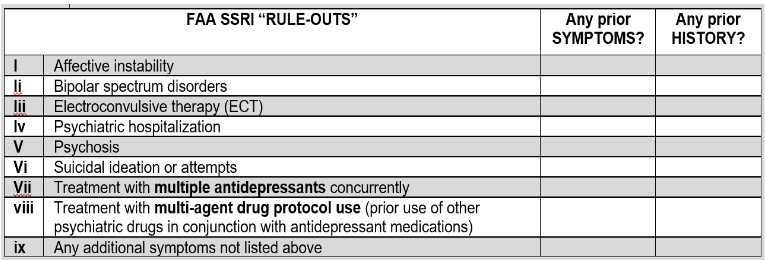 A Current detailed evaluation report that summarizes clinical findings and status of how the airman/FAA ATCS is doing. At a minimum, it must include the following: 1. Qualifications: State your board certifications, specialty, and any other pertinent qualifications. 2. Records review: What documents were reviewed? a. Specify if using your own clinic notes and/or notes from other providers or hospitals. b. Verify if you were provided with and reviewed a complete copy of the airman/FAA ATCS’s FAA medical file. 3. History: a. Review the overall symptom and treatment history, with a timeline of evaluations and treatments (including start and stop dates). b. Discuss the severity of the condition and any relapse/recurrence. c. Each of the FAA SSRI “Rule-Outs” below MUST be individually addressed. The report must specifically detail if there have been any symptoms or any history of the following:4. Medication a. Current name and dose of medication. b. How long has the airman/FAA ATCS been on this medication at this dosage? c. Any side effects from the current medications? (If none, that should be stated.) d. When was the most recent change in medication? (Dose, medication type, or discontinuation of medication.) e. Previous medications that have been tried. List name, dosage, dates of use, and presence or absence of any side effects and outcomes. f. Are additional changes in dose or medication recommended or anticipated? 5. Diagnosis: a. Specify the current diagnosis (es). b. Discuss any prior diagnostic questions or issues and explain why/how these are no longer under consideration or have been ruled-out. c. Discuss the severity of the condition, both current and historically. 6. Summary, Treatment and follow-up recommendations: d. Discuss the airman/FAA ATCS’s overall psychiatric and behavioral status and risk of recurrence. e. How will this airman/FAA ATCS be followed? At what interval? f. Do you have any clinical concerns or recommend a change in treatment plan? 7. Agreement to immediately notify the FAA if there is any changes in the airman/FAA ATCS’s condition, dosage, change in medication or if the medication is stopped. (For airmen: 405-954-4821; for FAA ATCS: contact the RFS office) 8. Submit copies of all treatment records such as clinic or hospital notes for any period of time which the airman/FAA ATCS has sought treatment or taken medication. (You do not need to submit any records received from the FAA.) |
FAA CERTIFICATION AID – SSRI INITIAL Certification (Page 4 of 5)
(Updated 08/26/2026) The following information is to assist your treating physician/ provider who may be unfamiliar with FAA medical certification/medical clearance requirements. It lists the ABSOLUTE MINIMUM information required by the FAA to make a determination on a medical certificate for airmen or medical clearance for FAA ATCS. You should strongly consider taking a copy to each evaluator so they understand what specific information is needed in their report to the FAA. If each item is not addressed by the corresponding provider, there may be a delay in the processing of your medical certification or clearance until that information is submitted. Additional information such as clinic notes or explanations should also be submitted as needed. All reports must be CURRENT (within the last 90 days) for FAA purposes.
| REPORT FROM | MUST SPECIFICALLY ADDRESS OR STATE THE FOLLOWING (SSRI INITIAL Certification/Clearance Evaluation) |
| NEUROPSYCHOLOGISTCogScreen ResultsANDNeurocognitive evaluation | The neuropsychologist report MUST address: 1. Qualifications: State your certifications and pertinent qualifications. 2. Records review: What documents were reviewed, if any? a. Specify clinic notes and/or notes from other providers or hospitals. b. Verify if you were provided with and reviewed a complete copy of the airman/FAA ATCS’s FAA medical file. 3. History: Items from the clinical, educational, training, social, family, legal, medical, or other history pertinent to the context of the neuropsychological testing and interpretation. 4. Testing results: a. CogScreen-AE information: i. Date(s) of evaluation ii. CogScreen-AE Session number. (Note: Session 1 should be for initial test only; retests should be Session 2 or incrementally higher.) iii. Normative group used for comparison:• Major Carrier (age-corrected); or• Regional Carrier (NOT age-corrected) [also acceptable for GA pilots]; or• General Aviation Pilot Norms (age-corrected) b. CogScreen-AE results with specific review of and discussion when any threshold values exceeded: i. LRPV (threshold: if score > 0.80) ii. Base Rate for scores at-or-below the 5th percentile (threshold: if any T-scores < 40) [age corrected acceptable] iii. Base Rate for scores at-or-below the 15th percentile (threshold: if any T-scores < 40) [age corrected acceptable] iv. Taylor Aviation Factors (threshold: if any T-scores < 40) c. Results of any additional focused testing or a comprehensive test battery 5. Interpretation: a. The overall neurocognitive status of the airman/FAA ATCS b. Clinical diagnosis (es) suggested or established base on testing (if any). c. Discuss any weaknesses or concerning deficiencies that may potentially affect safe performance of pilot or aviation safety-related duties (if any). d. Discuss rationale and interpretation of any additional focused testing or comprehensive test battery that was performed. e. Any other concerns. 6. Recommendations: additional testing, follow-up testing, referral for medical evaluation (e.g., neurology evaluation and/or imaging), rehabilitation, etc. 7. Agreement to immediately notify the FAA (for airmen: 405-954-4821; for FAA ATCS contact the RFS office) if there are any changes or deterioration in the airman/FAA ATCS’s psychological status or stability. 8. Submit the CogScreen-AE computerized summary report (approximately 13 pages) and summary score sheet for any additional testing (if performed). |
FAA CERTIFICATION AID – SSRI INITIAL Certification (Page 5 of 5)
(Updated 08/26/2026) The following information is to assist your treating physician/ provider who may be unfamiliar with FAA medical certification/medical clearance requirements. It lists the ABSOLUTE MINIMUM information required by the FAA to make a determination on a medical certificate for airmen or medical clearance for FAA ATCS. You should strongly consider taking a copy to each evaluator so they understand what specific information is needed in their report to the FAA. If each item is not addressed by the corresponding provider, there may be a delay in the processing of your medical certification or clearance until that information is submitted. Additional information such as clinic notes or explanations should also be submitted as needed. All reports must be CURRENT (within the last 90 days) for FAA purposes.
| REPORT FROM | MUST SPECIFICALLY ADDRESS OR STATE THE FOLLOWING (SSRI INITIAL Certification/Clearance Evaluation) |
| AIR TRAFFIC MANAGER (ATM)FAA ATCS employeesFAA ATCS Applicant for Hire – Not applicable | Report should address:For FAA ATCS: 1. Issues related to safety and safe operations. 2. Interaction with other FAA ATCSs. 3. Mood and behavioral changes. 4. Any other concerns.For Pilots: Chief pilot reports no longer required. |
| REPORTS FROM ADDITIONAL PROVIDERSORREPORTS REGARDING OTHER CONDITIONS | Supplemental reports (if any) that may be related to the condition for which the SSRI is prescribed:• Any drug testing results• Psychotherapist records and reports• Social worker reportsSpecial Issuance/ Special Consideration conditions: The airman/FAA ATCS should bring reports and documentation for any other conditions that may require Special Issuance/Special Consideration to the HIMS AME for review.CACI conditions (airman only): The airman should bring reports or other documentation listed on the CACI worksheet to the HIMS AME for review. |
SSRI RECERTIFICATION/FOLLOW-UP CLEARANCE
(Updated 12/28/2022) Policy Change in SSRI Program Cognitive Testing Requirements for Renewal of Special Issuance:
After careful study of data from 425 pilots in the SSRI Program, the FAA has determined that the neuropsychologist evaluation and routine CogScreen-AE administration are no longer necessary for RENEWAL of an SSRI special issuance, except when clinically indicated or specified on the Authorization/Special Consideration Letter. This policy change does NOT affect initial evaluations and the current AME checklists and Specifications for Neuropsychological Evaluations should still be used. This policy is effective immediately (12/15/2022).
Frequently Asked Questions (FAQs)
Does the policy change apply to all classes of pilots and ATCS?
Yes.
Is a Neuropsychology follow up evaluation still required?
No. This policy change eliminates both the neuropsychologist evaluation and CogScreen for follow up evaluations (unless the pilot/ATCS receives a specific request for follow-up).
My pilot/ATCS is currently on an Authorization for the SSRI program. Their current Authorization letter states they need CogScreen. Can I issue without a follow-up CogScreen and Neuropsychology evaluation based on the 12/15/2022 policy change?
Yes. If all other items of the HIMS AME Checklist – SSRI Recertification/Follow-Up Clearance are in the clear column and they are otherwise qualified, issue with a 6-month time limitation. Submit all information to the FAA for review.
What will happen when the case is reviewed at the FAA?
All SSRI cases are reviewed by a FAA psychiatrist.
As each case is reviewed, a new Authorization letter may be generated.
In most cases, the requirement for a follow-up CogScreen will be removed.
For a small number of cases, a follow up CogScreen may be required. This information will be on the Authorization Letter.
If my pilot/ATCS receives a letter asking for a new CogScreen, can they fly in the meantime?
Yes, if otherwise qualified. There will be some overlap in letters that were sent out prior to 12/15/2022 which asked for a follow-up CogScreen. If the pilot/ATCS has already completed the CogScreen from the previous letter, the AME should review and send it to the FAA.
If the pilot/ATCS has provided all items to the HIMS AME except the CogScreen and Neuropsychology evaluation (for follow-up SSRI Authorization), the AME can issue if all items are in the clear column of the HIMS AME Checklist – SSRI Recertification/ Follow-Up Clearance.
Is there a possibility that the aviator will be grounded due to the results of the CogScreen results?
If the results were severe and were thought to identify significant cognitive deficits, the Special Issuance would be temporarily withdrawn while further evaluation is completed.
Does the policy change apply to pilots/ATCS who are not yet on an Authorization for SSRI?
Not at this time. There is no change to the current INITIAL Authorization requirements.
________________________________________________________________________
Note: See important update in black boxes above. Neuropsychologist report and routine CogScreen-AE administration are no longer necessary for RENEWAL of an SSRI special issuance, except when clinically indicated or specified on the Authorization/Special Consideration Letter. This policy change does NOT affect initial evaluations and the current AME checklists and neuropsychological protocol should still be used. (Policy change 12/15/2022)
HIMS AME Checklist - SSRI Recertification /Follow Up Clearance (Updated 08/26/2026) [Note: SSRI now called Antidepressant]
Name ____________________________ Airman PI#____________________________
Instructions to the HIMS AME:
Address the following items based on your in-office exam and documentation review;
Submit this Checklist (signed and dated by the HIMS AME); AND include supporting documentation reviewed to complete this Checklist (including your HIMS AME report) within 14 days to:
- AIRMAN
- FAA, Civil Aerospace Medical Institute, Bldg. 13
- Aerospace Medical Certification Division, Room 308 -
- AAM-300
- PO Box 25082
- Oklahoma City, OK 73125-9867
- FAA ATCS: Regional Flight Surgeon (RFS) office
I reviewed the airman’s SSRI Authorization or the FAA ATCS’s Special Consideration Letter dated: ________________ (Date of Letter) 1. HIMS AME FACE-TO-FACE, IN OFFICE EVALUATION: Required EVERY 6 months for ALL CLASSES
Interval visit summaries (if any) are unfavorable or reflect concerns………………………………………
Any concerns about the airman/FAA ATCS’s current psychiatric status based on your clinical interview, evaluation, and review of reports? ………………………………………………….....................
Any new psychiatric conditions identified or change in medication or dose during this period? ............
Any abnormal physical exam or mental exam findings? ……………………………………………………
Any NEW condition(s) that would require Special Issuance/Consideration? (Do not include any new
CACI qualified condition.) ……………………………………………………………………………………….
TREATING PSYCHIATRIST REPORT: Required EVERY 6 months for ALL CLASSES
OR
HIMS PSYCHIATRIST REPORT plus PRESCRIBING PHYSICIAN REPORT
Report(s) is/are favorable with no anticipated or interim treatment changes ……………………………..
The airman/FAA ATCS is on the same medication at the same dose stated in the Authorization letter
or Special Consideration Letter.………...........................................................................................
NEUROPSYCHOLOGIST REPORT and routine CogScreen-AE administration are no longer necessary for renewal of an SSRI special issuance, except when clinically indicated or specified on the Authorization Letter /Special Consideration Letter. (Policy change 12/15/2022)
If indicated/specified, answer the following items:
Concludes NO aeromedically significant cognitive deficits or adverse changes? ....................................................
CogScreen is attached? ……………………………………………………………………………………………………..
Additional neuropsych testing (if performed or required) is attached? .....................................................................
(ATCS only) AIR TRAFFIC MANAGER (ATM) REPORT(S): Required EVERY 3 months
(Mark N/A for pilots) Reports are favorable? .........................…………………………………………...
If any report is unfavorable immediately FAA RFS office.
ADDITIONAL REPORTS required by Authorization letter
SSRI-related (drug testing, therapy reports, etc.) reports are favorable…………….................
Reports required for other non-SSRI conditions meet Authorization requirements……………
I have no other concerns about this airman/FAA ATCS and I recommend re-certification for Special
Issuance/Consideration……………………………………………………………………………………….................
______________________________ __________________________________
HIMS AME Signature Date of Evaluation
For Airman: If ALL items fall into the clear column, the AME may issue with the time limitation specified in the Authorization Letter or Special Consideration Letter. If Any Single Item falls into the shaded column, the AME MUST DEFER or contact the FAA and Explain in the HIMS report. For FAA ATCS: When Checklist is complete, immediately contact RFS with results and submit all documents within 14 days.
No Yes
FAA CERTIFICATION AID – SSRI Recertification
Page 1 of 2 (Updated 08/26/2026) The following information is to assist your treating physician/ provider who may be unfamiliar with FAA medical certification requirements. It lists the ABSOLUTE MINIMUM information required by the FAA to make a determination on a medical certificate for airmen or medical clearance for FAA ATCS. You should strongly consider taking a copy to each evaluator so they understand what specific information is needed in their report to the FAA. If each item is not addressed by the corresponding provider there may be a delay in the processing of your medical certification until that information is submitted. Additional information such as clinic notes or explanations should also be submitted as needed. All reports must be CURRENT (within the last 90 days) for FAA purposes.
| REPORT FROM | REQUIRED INTERVAL | MUST SPECIFICALLY ADDRESS OR STATE THE FOLLOWING (SSRI Recertification/ Follow Up Clearance) |
| HIMS AMEAll classes and FAA ATCS | Every 6 months or as stated in the airman Authorization letterOr FAA ATCS Special Consideration Letter | 1. Must be a face-to-face, in person evaluation every 6 months. 2. Summarize findings from additional interim evaluations that were performed by any other venue (phone/ video/ email), either at the AME’s discretion or as required by the Authorization or Special Consideration Letter (every 1-3 months). 3. Summarize your aeromedical impression and evaluation as a HIMS AME based on the face-to-face evaluation AND review of the supporting documents. 4. If you do not agree with the supporting documents, or if you have additional concerns not noted in the documentation, please discuss your observations or concerns. 5. State if the airman/FAA ATCS meets all the requirements of the Authorization Letter/Special Consideration Letter or describe why they do not. 6. Review and comment if there has been any change in the dose, type, or discontinuation of medication stated in the Authorization Letter/ Special Consideration Letter. 7. Do you recommendation continued Special Issuance/Special Consideration in this airman/FAA ATCS? 8. Agreement to continue to serve as the airman/FAA ATCS’s HIMS AME and follow this airman/FAA ATCS per FAA policy. 9. Agreement to immediately notify the FAA (for airmen: 405-954-4821; for FAA ATCS contact the RFS office) if there is any change in condition, deterioration in psychiatric status or stability, if the medication dosage has changed, or there is a plan to reduce or discontinue any medication. 10. Using the HIMS AME Checklist –SSRI Recertification/ Follow Up Clearance, comment on any items that fall into the shaded category. 11. Submit the SSRI check list, your HIMS AME written report, and all required supporting documentation that you reviewed with your package. |
| PSYCHIATRIST INTERIM HISTORY REPORT (or treating physician as noted in the Authorization letter)If the prescribing physician is not a psychiatrist, items #2-7 must be submitted from the prescribing physician IN ADDITION TO the psychiatrist report. | Every 6 months or per Authorization LetterOr FAA ATCS Special Consideration Letter | 1. Summarize clinical findings and status of how the airman/FAA ATCS is doing. 2. Have there been any new symptoms or hospitalizations? 3. Did a change in dose or medication occur or is one recommended or anticipated? 4. Have there been any clinical concerns or changes in treatment plan? 5. Has the clinical diagnosis changed? 6. Agreement to immediately notify the FAA (for Airmen: 405-954-4821; for FAA ATCS: contact the RFS office) if there is any change in the airman/FAA ATCS’s condition, dosage, change in medication or if the medication is stopped. 7. Interval treatment records such as clinic or hospital notes should also be submitted. |
FAA CERTIFICATION AID – SSRI Recertification
Page 1 of 2 Updated 08/26/2026) The following information is to assist your treating physician/ provider who may be unfamiliar with FAA medical certification requirements. It lists the ABSOLUTE MINIMUM information required by the FAA to make a determination on a medical certificate for airmen or medical clearance for FAA ATCS. You should strongly consider taking a copy to each evaluator so they understand what specific information is needed in their report to the FAA. If each item is not addressed by the corresponding provider there may be a delay in the processing of your medical certification until that information is submitted. Additional information such as clinic notes or explanations should also be submitted as needed. All reports must be CURRENT (within the last 90 days) for FAA purposes.
- REPORT FROM REQUIRED
- INTERVAL
- MUST SPECIFICALLY ADDRESS OR STATE THE FOLLOWING
- (SSRI Recertification/ Follow Up Clearance)
- CLINICAL PSYCHOLOGIST
- OR
- NEUROPSYCHOLOGIST*
*Neuropsychologist report and routine CogScreen-AE administration are no longer necessary for RENEWAL of an SSRI special issuance, except when clinically indicated or specified on the Authorization/Special
Consideration Letter.
- (Policy change 12/15/2022)
- 1st and 2nd class: Every
- 12 months or per Authorization Letter
- FAA ATCS: Every 12 months or per the Special Consideration
- Letter
- 3rd class: Every 24 months or per Authorization Letter
CogScreen information results that must be addressed in the narrative:
Specify the norm used:
Major Carrier (age-corrected); or
Regional Carrier (NOT age-corrected) [also acceptable for GA pilots]; or
General Aviation Pilot Norms (age-corrected)
Specify Session Number administered (listed on Page 1 and Page 2 of printout).
Session 1 for initial test only; retests should be Session 2 or incrementally higher.
Clinical report MUST specifically comment on the following CogScreen items. If they have changed or are not normal, the narrative must discuss these findings and if they are of any clinical or aeromedical concern:
Any increase in LRPV (page 4)
Taylor Factor scores (page 5)
Base Rate for Speed, Accuracy, or Process (page 4)
The psychologist or neuropsychologist report should also specifically mention:
The overall neurocognitive status of the airman/FAA ATCS.
Any adverse neurocognitive findings or a decline in condition.
If additional focused neuropsych testing is/was required or recommended. If any additional testing was performed, the report must explain why the testing was performed, the results, and how that fits into the airman/FAA ATCS’s overall neurocognitive status.
Any other concerns or absence of concerns.
Agreement to immediately notify the FAA (for Airmen: 405-954-4821; for FAA
ATCS: contact the RFS office) if there is any change or deterioration in the psychological status or stability in the airman/FAA ATCS’s condition.
Submit the entire CogScreen report (approximately 13 pages) and any additional testing (if performed).
- AIR TRAFFIC MANAGER (ATM)
- FAA ATCS employee
- ATCS Applicant for hire – Not applicable
FAA ATCS: Every 3 months (bring cumulative reports to AME evaluation every 6 months.)
Report must address:
For FAA ATCS:
Issues related to safety and safe operations.
Interaction with other FAA ATCSs.
Mood and behavioral changes.
Any other concerns.
For Pilots: Chief pilot reports no longer required.
ADDITIONAL PROVIDERS
Additional reports for SSRI or any other condition noted in Authorization or FAA ATCS Special Consideration
- Letter
- Every 6 months or per Authorization or FAA
- ATCS Special
Consideration Letter Varies. See the Authorization Letter or Special Consideration Letter. Include any drug testing results, therapist follow up reports, social worker reports, etc.
If the prescribing physician is NOT a psychiatrist, reports from the prescribing physician and their clinic office notes must be submitted in addition to the required psychiatric evaluations (see above).
If the airman/FAA ATCS has other non-SSRI conditions that require a special issuance/consideration, those reports should also be submitted according to the Authorization or FAA ATCS Special Consideration Letter.
HIMS AME CHANGE REQUEST
(Updated 09/25/2024) The Authorization for Special Issuance requires that individuals DO NOT change his/her HIMS AME without prior FAA approval.
In rare cases in which the HIMS AME listed on the Authorization Letter is no longer available to the individual (ex: HIMS AME retires, is no longer a HIMS AME, is deceased, or the individual or HIMS AME relocates to a new state, etc.), a change request is required.
The FAA requires the following to consider any request:
The INDIVIUAL must send a written request to the FAA (address below) describing why there is a requirement to work with the new requested/prospective HIMS AME.
In addition, the individual must give FAA Office of Aerospace Medicine authorization to release a complete copy of their FAA Medical File to the new requested/prospective HIMS AME in advance of the new requested/prospective HIMS AME’s agreement to monitor the individual. For information on how to accomplish this, see Requesting Medical Records.
The CURRENT HIMS AME must write a closeout status report describing why the change is requested and agree to release HIMS AME monitoring services to the new requested/prospective HIMS AME (list the name of new HIMS AME).
The closeout report must note if there are any concerns regarding the individual’s compliance.
If the (current) HIMS AME is deceased, his/her office staff should contact AAM-200 Manager, Medical Specialties in Washington, DC at (202) 267-8035.
NEW REQUESTED/PROSPECTIVE HIMS AME must review the individual’s records and, in writing, agree to monitor the individual in accordance with the terms of the FAA SI Authorization Letter.
The FAA will review the submitted information, and IF the change is approved*, will send an updated Authorization Letter with the new HIMS AME information to the individual.
Submit requests to:
- Federal Aviation Administration
- Civil Aerospace Medical Institute, Bldg. 13
- Aerospace Medical Certification Division, AAM-313
- PO Box 25082, Oklahoma City, OK 73125-9867
*NOTE: Submission of a HIMS AME Change Request does not automatically guarantee approval of the request.
- ATTENTION-DEFICIT/HYPERACTIVITY DISORDER (ADHD)*
- AND/OR USE OF ADHD MEDICATIONS
- All Classes
- (Updated 10/30/2024)
| DISEASE/CONDITION | EVALUATION DATA | DISPOSITION |
|---|---|---|
| A. NO treatment or use of ADHD medication (for any reason) in past four (4) yearsANDNO symptoms in past four (4) yearsANDNO instability in academic, occupational, or social functioning within the last four (4) yearsANDNO other psychiatric condition(s) or diagnosis (current or historical).Exception: Anxiety, Depression, and Related Conditions can use this row if the individual qualifies for the Anxiety, Depression, and Related Conditions Fast Track Pathway. | The individual will need to see a psychologist or neuropsychologist for records review and evaluation*. This section may be performed in person or virtually (in compliance with State and Federal regulations).*Note: Records review and evaluation can be done virtually; however, the evaluation component must be face-to-face on screen, not audio only.• See Fast Track - FAA ADHD Evaluation General Information for Pilots and ATCS• The AME should review the FAA ADHD Summary completed by a psychologist or neuropsychologist who has training and experience in the evaluation of ADHD.If the FAA ADHD Summary is provided, all items are in the “NO” category, and the AME has NO concerns regarding this individual:Note: If FAA ADHD Summary is not provided, any “YES” answers, any AME concerns, or unable to verify history, go to Row B. |  ISSUE Summarize this history, annotate Block 60 “Meets ADHD Fast Track requirements.”Submit ALL the following to the FAA:1. Completed and signed FAA ADHD Summary;2. Actual clinical visit report (not patient portal notes) from the psychologist or neuropsychologist ; and3. Copies of ALL supporting documents reviewed. |
| B. Symptoms, treatment or use of ADHD Medication (for any reason), or instability in past four (4) yearsORHistory of any psychiatric condition(s) or diagnosis (current or historical) including Anxiety, Depression, and Related Conditions which do not qualify for the Anxiety, Depression, and Related Conditions Fast Track Pathway.ORAME and/or HIMS Neuropsychologist have any concerns | This row requires HIMS neuropsychology evaluation and testing to identify the presence of aeromedically significant ADHD.• Evaluation and testing must be completed in person by a HIMS neuropsychologist;• ADHD testing is required after record review; and• The HIMS Neuropsychologist should reference the Standard Track - FAA ADHD Evaluation General Information for Pilots and ATCS.Medication: If the individual stopped taking ADHD medication(s), they must be off the medication(s) for 90 days before testing and evaluation. |  DEFER Submit the information to the FAA. |
| C. Currently taking ADHD medication (for any reason), including PRN useORMedication discontinued within the past 90 daysORCurrent symptoms | Taking ADHD medication or symptoms of ADHD are incompatible with aviation safety.Submit the following for FAA review: The most recent detailed, clinical progress note from the prescribing physician which identifies the diagnosis and treatment plan.If the treating physician determines the medication can be safely discontinued, the individual should be off the medication a minimum of 90 days before obtaining the Standard Track - FAA ADHD Evaluation See Row B. |  DEFER Submit the information to the FAA |
*ADHD has replaced the former name Attention-Deficit Disorder (ADD).
- ANXIETY, DEPRESSION, AND RELATED CONDITIONS
- All Classes
(Updated 06/26/2024) Row A on the following Anxiety, Depression, and Related Conditions Disposition Table allows only TWO of the following:
Anxiety
Unspecified anxiety
Generalized Anxiety Disorder
Situational anxiety (also called adjustment disorder with anxiety)
Social Anxiety Disorder
Depression
Unspecified depression
Postpartum depression
Situational depression* (also called adjustment disorder with depressed mood) *For Situational Depression - AME can also use the Situational Depression Disposition Table.
Situational Anxiety and Depression (adjustment disorder with mixed anxiety and depressed mood)
Other
Obsessive Compulsive disorder (OCD)
Post Traumatic Stress Disorder (PTSD)
V code^ (DSM)/Z code (ICD-10) table items
Note^: V code (DSM)/Z code (ICD-10) table includes but is not limited to:
Uncomplicated Bereavement;
Relationship distress with spouse or intimate partner;
Parent-Child relational problem; and/or
Phase of Life Problem (problems adjusting to major life transitions such as newly retired, getting married, empty-nest, new career, becoming a parent, etc.
Review ALL Row A criteria including psychotherapy (past and current) and medication history.
For conditions not listed above, see Row B.
- ANXIETY, DEPRESSION, AND RELATED CONDITIONS
- All Classes
- (Updated 06/26/2024)
| DISEASE/CONDITION | EVALUATION DATA | DISPOSITION |
|---|---|---|
| A. Up to TWO listed conditions treated with any combination of:• Psychotherapy (current or historical)• Medication: A single mental health medication last taken, prescribed, or recommended two (2) or more years ago. o This includes when the treating physician changed medications for better treatment response, provided only ONE medication was taken at a time and last use was two or more years ago.ACCEPTABLE DIAGNOSES:Uncomplicated:1. Anxiety:• Generalized Anxiety Disorder• Situational anxiety (aka adjustment disorder with anxiety)• Social Anxiety Disorder• Unspecified anxiety2. Depression:• Postpartum depression• Situational depression* (aka adjustment disorder with depressed mood)• Situational• Anxiety and Depression (adjustment disorder with mixed anxiety and depressed mood)• Unspecified depression | The AME should gather information regarding the diagnosis, severity, treatment, symptoms, and address ALL of the questions on the Anxiety, Depression, and Related conditions Decision Tool for the AME.Note: For individuals who were deferred, but now may possibly meet all Row A criteria, use the FAST TRACK PATHWAY Decision Tool for Currently Deferred Cases.If all items on the decision tool are in the clear, “NO column, the AME may:DO NOT USE THIS ROW IF (go to Row B):⊗ Previously on an SI/SC for SSRI use;⊗ Recurrent episodes or symptoms. If the individual had multiple failed attempts to discontinue or stay off medication(s) over any period;⊗ If the individual has any history of requiring more than ONE mental health medication at a time (e.g., dual or triple therapy); and/or⊗ Diagnosed with Major Depressive Disorder (MDD) or Persistent Depressive Disorder (dysthymia).NOTE^: V code (DSM)/Z code (ICD-10) table includes:• Uncomplicated Bereavement;• Relationship distress with spouse or intimate partner;• Parent-Child relational problem; and/or• Phase of Life Problem (problems adjusting to major life transitions such as newly retired, getting married, empty-nest, new career, becoming a parent, etc. |  ISSUESummarize this history, diagnosis, and annotate Block 60:“Discussed the history of [insert diagnosis here], no positives to screening questions, and no concerns.”If any “YES” answersORAny AME concerns:DEFER |
| 3. Other:• Obsessive Compulsive disorder (OCD)• Post-Traumatic Stress Disorder (PTSD)• V code^ (DSM)/Z code (ICD-10) table itemsNote*: For Situational Depression - AME can use this table or the Situational Depression Disposition Table. | ||
| B. All Others• Previously on an SI/SC for SSRI use;OR• Recurrent episodes or symptoms. If the individual had multiple failed attempts to discontinue or stay off medication(s) over any period;OR• If the individual has any history of requiring more than ONE mental health medication at a time (e.g., dual or triple therapy);OR• Diagnosed with Major Depressive Disorder (MDD) or Persistent Depressive Disorder (dysthymia);AND/OR• Seasonal Affective Disorder | Submit a current, detailed Clinical Progress Note generated from a clinic visit with the treating physician or specialist no more than 90 days before the AME exam. |  DEFERAnnotate (elements or findings) in Block 60. |
- ANXIETY, DEPRESSION, AND RELATED CONDITIONS
- FAST TRACK PATHWAY Decision Tool for Current Deferred Cases
- ALL CLASSES (Updated 09/25/2024) – (Page 1 of 2)
AME instructions: If a pilot was previously deferred for anxiety, depression, or related conditions, they MAY now qualify for consideration per Row A of the Anxiety, Depression, and Related Conditions Disposition Table (published 05/29/2024). Complete the following and upload into AMCS:
APPLICANT NAME:_________________________________________________ BIRTHDATE:__________________________ APPLICANT ID#:___________________________________________________ PI#:__________________________________ A. Diagnosis: Does the individual have 3 or more of the following conditions/ diagnosis as the reason for deferral?
Circle all conditions diagnosed:
Anxiety
Unspecified anxiety
Generalized Anxiety Disorder
Situational anxiety (also called adjustment disorder with anxiety)
Social Anxiety Disorder
Depression
Unspecified depression
Postpartum depression
Situational depression* (also called adjustment disorder with depressed mood)
Situational Anxiety and Depression (adjustment disorder with mixed anxiety and depressed mood)
Other
Obsessive Compulsive disorder (OCD)
Post Traumatic Stress Disorder
(PTSD)
V code^ (DSM)/Z code (ICD-10) table items o Uncomplicated Bereavement;
o Relationship distress with spouse or intimate partner;
o Parent-Child relational problem;
and/or o Phase of Life Problem (problems adjusting to major life transitions such as newly retired, getting married, empty-nest, new career, becoming a parent, etc.
B. Treatment: Has the individual been on an antidepressant medication in the past two (2) years?
Date medication stopped _______________.
If currently treated with psychotherapy, check here ______.
C. Multiple medications use: Has the individual used multiple medications concurrently? This includes augmentation therapy. Circle all medications used:
Selective serotonin reuptake inhibitors (SSRI):
citalopram (Celexa) escitalopram (Lexapro) fluoxetine (Prozac; Sarafem) sertraline (Zoloft)
Serotonin and norepinephrine reuptake inhibitors (SNRI):
desvenlafaxine (Pristiq) duloxetine (Cymbalta) venlafaxine (Effexor)
Dopamine/norepinephrine-reuptake inhibitor (NDRI):
buproprion (Wellbutrin) SR/ER formulations
Other _________________________________________________________________ Note: Historic use of an antidepressant not on the above list does not exclude this pathway.
D. Do Not Issue/Do Not Fly Medications: Has the individual ever been treated with:
Antipsychotics (neuroleptics)
Benzodiazepines
Mood stabilizers (lithium, anti-epileptics)
Stimulants
E. History: Does the individual have any history of:
⊗ SI/SC for SSRI use (current or previous);
⊗ Recurrent episodes or symptoms. If the individual had multiple failed attempts to discontinue or stay off medication(s) over any period;
⊗ If the individual has any history of requiring more than ONE mental health medication at a time (e.g., dual or triple therapy); and/or ⊗ Diagnosed with Major Depressive Disorder (MDD) or Persistent Depressive Disorder (dysthymia) or Seasonal Affective Disorder.
- NO YES*
- NO YES*
- NO YES*
- NO YES*
- NO YES*
F. Answer all of the following:
(Page 2 of 2)
Does the individual have any additional mental health diagnosis or symptoms such as bipolar disorder, psychosis, neuro-developmental disorder, autism, personality disorder, somatoform disorder, impulse control disorders, substance misuse or disorder, eating disorder, or any diagnosis NOT listed as acceptable? (Note: ADHD
that does not meet ADHD Fast Track Requirements is NOT acceptable.) ...................
Any history of suicidal (or homicidal) ideation, attempt(s), or self-harm behavior (such
as cutting) ever in their life?...........................................................................................
Any history of an involuntary mental health or substance use evaluation (including
involuntary transport) and/or court-ordered treatment?.................................................
Any history of any forms of the following treatment modalities: Electroconvulsive (ECT), Transcranial Magnetic Stimulation (TMS), Ketamine, or Psychedelic
therapy?.........................................................................................................................
Any history of a mental health hospitalization (psychiatric or substance use)?...........
Has the individual experienced more than one episode? (This includes recurrent
episodes spaced out over an extended period of time.)................................................
This condition has unresolved sequelae or continued symptoms severe enough to interfere with safety related duties…………………………………………………………..
Mental health medications: Multiple medications have been used at the same time
OR use of any medication has continued during the last two years..……................
Does the licensed mental health specialist, treating clinician, or the AME have ANY
concerns?.....................................................................................................................
The AME who submitted the exam must verify that ALL items fall into the “NO”/CLEAR COLUMN to use this FAST TRACK pathway. If any items fall into the “YES” column, STOP. The individual does not qualify for the FAST TRACK pathway.
The AME should warn the individual if any changes in condition, symptoms or medications started, they should not fly in accordance with CFR 61.53.
- AME name _________________________________ AME number ____________
- Signature __________________________________ Date of exam ___________
- NOTES:
This FAST TRACK Pathway Decision Tool:
Must be completed by the AME of record.
May be submitted if the individual has received a request for information for above conditions.
In some cases, additional information will be required.
MUST be uploaded into AMCS for FAST TRACK consideration. Use category Beh Hlth – Anxiety/Depression FAST Track Summary.
- NO YES*
- NO YES*
- NO YES*
- NO YES*
- NO YES*
- NO YES*
- NO YES*
- NO YES*
- NO YES*
- ANXIETY, DEPRESSION, AND RELATED CONDITIONS
- DECISION TOOL FOR THE AME
- All Classes
(Updated 09/25/2024) AME Instructions: Address each of the following items in your in-office exam and history review. Only uncomplicated anxiety, depression, and related will qualify for this pathway. (See disposition table for conditions.) The AME must list all diagnoses in Block 60.
Does the individual have any additional mental health diagnosis or symptoms such as bipolar disorder, psychosis, neuro-developmental disorder, autism, personality disorder, somatoform disorder, impulse control disorders, substance misuse or disorder, eating disorder, or any diagnosis NOT listed as acceptable? (Note: ADHD that does not meet ADHD Fast Track Requirements is NOT acceptable.)
……………………………………………………………………………….
Any history of suicidal (or homicidal) ideation, attempt(s), or self-harm behavior (such as cutting) ever in their life?............................................................................
Any history of an involuntary mental health or substance use evaluation (including
involuntary transport) and/or court-ordered treatment? ...........................................
Any history of any forms of the following treatment modalities: Electroconvulsive (ECT), Transcranial Magnetic Stimulation (TMS), Ketamine, or Psychedelic
therapy?....................................................................................................................
Any history of a mental health hospitalization (psychiatric or substance use)?.....
Has the individual experienced more than one episode? (This includes recurrent
episodes spaced out over an extended period of time.)………………………………
This condition has unresolved sequelae or continued symptoms severe enough to interfere with safety related duties……………………………………………………
Mental health medications: Multiple medications have been used at the same time OR use of any medication has continued during the last two years.”….….
Does the licensed mental health specialist, treating clinician, or the AME have ANY
concerns? ......................................................................................................
If ALL items fall into the “NO”/CLEAR COLUMN, the AME may issue with notes in Block 60 which show the AME discussed the history of Uncomplicated Anxiety, Depression, and Related Conditions, found no positives to the screening questions, AND had no concerns.
*If ANY SINGLE ITEM falls into the “YES”/SHADED COLUMN, the AME MUST DEFER. The AME report should note what aspect caused the deferral and explain any YES answers.
NOTES:
If the AME is unsure of any of the above criteria, DEFER and note in Block 60.
This decision tool is for AME use; it may be submitted to the FAA for retention in the file.
- NO YES*
- NO YES*
- NO YES*
- NO YES*
- NO YES*
- NO YES*
- NO YES*
- NO YES*
- NO YES*
PATH Status Summary Anxiety, Depression, and Related Conditions
(Updated 07/29/2026)
Name: _______________________________ Birthdate: ______________________ Applicant ID: __________________________ PI#: ___________________________
Pilots/ATCS (Air Traffic Control Specialists). If you do not have a Special Issuance (SI) /Special Consideration (SC), STOP. Do not use this page.
If your SI/SC letter places you in the PATH program, have your treating clinician complete Section 1, then bring this signed page and all interim detailed clinical progress notes (DCPN) to your AME for review and upload them into your FAA file.
Section 1. Treating clinician. Please answer questions 1 and 2, sign, and return this form to the patient or their Aviation Medical Examiner (AME). See the DCPN criteria, as a letter to the FAA may not contain all the needed information.
In the past 12 months, did the individual have:
Any prolonged, clinically significant worsening in cognition, judgment, emotional stability, insight, or function?
Any newly disclosed arrests, convictions, incarcerations, or significant episodes of intense anger or affect, hostility, threats, coercive/controlling behavior, stalking, domestic violence, significant impulsivity or risk-taking, assault, restraining orders, or other interpersonal violence?
Your patient should self-report and abstain from safety-related duties (pilot/ATCS) when they have a medical deficiency (e.g., worsening of condition, symptoms, etc). However, if your patient experiences a significant clinical deterioration in cognition, judgment, emotional stability, or insight and lacks the awareness to ground themselves, please notify the FAA Aeromedical Certification Division (405-954-4821) or their AME.
______________________________________________________________________________________ Treating Clinician Printed Name Office Phone Number Date of Evaluation
______________________________________________________________ _________________ Signature MD, DO, PA-C, NP
Section 2. AME Actions. Review Section 1 and all detailed clinical progress notes. Complete #3 and #4, and sign. Upload this page (as “Beh Hlth - PATH Status Summary”) and all interim detailed clinical progress notes.
Any evidence of symptom exacerbation, functional decline, or clinical deterioration concerning for impaired ability to safely operate in the National Airspace?
I HAVE CONCERNS regarding their status [e.g., identified concerns in the progress notes or performed a standard screening tool for their condition(s) and identified concern(s)].
Explain any “Yes*” answers or other concerns (attach any supporting documents).
I will notify the FAA Aeromedical Certification Division (405-954-4821) if there is a significant clinical deterioration in this individual’s cognition, judgment, emotional stability, or insight.
________________________________________ _______________
AME signature Date of Evaluation *IF ANY ANSWER FALLS IN THE YES* COLUMN, OR THERE HAS BEEN SIGNIFICANT INTERVAL HISTORY WORSENING OR ANY CONCERNS, THE AME MUST DEFER.
- No Yes*
- No Yes*
- No Yes*
- No Yes*
POST-TRAUMATIC STRESS DISORDER (PTSD)
All Classes
(Updated 06/26/2024)
| DISEASE/CONDITION | EVALUATION DATA | DISPOSITION |
|---|---|---|
| A. NO Treatment with SSRI or other psychiatric medications in the past 2 years.ANDNO symptoms in past 2 yearsNote: Previous or on-going psychotherapy is permitted. | The AME should gather information regarding the diagnosis, severity, treatment, symptoms, and address ALL of the questions on the Anxiety, Depression, and Related Conditions Decision Tool for the AME. |  If all items on the decision tool are in the clear “No column”, the AME may:ISSUE Summarize this history, and annotate Block 60 with “discussed the history of PTSD, no positives to screening questions, and no concerns.”If any “YES” answers, any AME concerns, or unable to verify history, go to Row B. |
| B. All others including:• Continued symptoms; and/or• Treatment with SSRI or other psychiatric medication in the previous two years. | Submit the following to the FAA for review:1. Airman personal statement (typed) that describes in their own words: a. The incident(s) leading up to PTSD-related symptoms and the eventual diagnosis of PTSD. b. Triggers for PTSD symptoms - characterize the frequency and severity of the symptoms (flashbacks, nightmares, anxiety, avoidance, and cognitive changes). c. Impact - include any recent or ongoing performance change, loss of job/school, or relationship problems due to PTSD. d. Modifications - include any recent or current changes to work, academic, or living situation to accommodate or lessen the PTSD symptoms. e. Medication - list names and dates (if used); f. Counseling - include any form of individual or group counseling or psychotherapy. List dates and provider(s) name(s). |  DEFER Submit the information to the FAA for a possible Special Issuance.Follow up Issuance Will be per the airman’s authorization letter. |
| 2. Current evaluation by your treating psychiatrist or psychologist with clinical summary to include severity, frequency of episodes, and response to treatment (medications or psychotherapy). The report should identify if there is any history of suicidal ideation(s), homicidal ideation(s), substance use disorder(s) or other co-morbid psychiatric or psychological conditions, and identify diagnosis (DSM-V), treatment plan, and prognosis.3. Medication list. List all current medications (including non-PTSD related medications), reason for use, start dates, and side effects, if any. If recently discontinued, list date and reason. Note: if currently on an SSRI, must also submit items in the Initial SSRI Protocol.4. Copies of any PTSD screening tools or other assessment instruments (already performed).5. Copies of psychological testing (already performed) including raw data.6. Veterans Administration (VA) records (if applicable) a. VA Compensation and Pension disability evaluations (C&P exam); b. VA Disability Compensation Award letters; and c. VA clinic and/or hospital records 7. Previous medical/hospital records including previous clinical progress notes for any psychiatric evaluations and clinical progress notes for any psychiatric condition or PTSD that describe the dates, severity, and any treatment used. |
SITUATIONAL DEPRESSION
- Adjustment Disorder with Depressed Mood or MINOR Depression
- All Classes
- (Updated 07/27/2022)
| DISEASE/CONDITION | EVALUATION DATA | DISPOSITION |
|---|---|---|
| A. Single episode Completely resolvedCAUTION:Depression(s) requiring treatment longer than 6 monthsORNOT resolved within 6 months AFTER the resolution of the event/stressorARE NOT adjustment disorders. While they may have a situational component, they are likely a Major Depressive Disorder (MDD) or other significant depressive diagnosis. | The AME should gather information regarding the diagnosis, severity, treatment, symptoms, and address ALL of the questions on the Situational Depression Decision Tool for the AME.If 5 or more years ago; treatment was not more than 6 months from the resolution of the stressor; there is no history of self-harm, psychiatric hospitalization, or persisting symptoms - the FAA will accept the AME history and notes in Block 60.If the single episode was LESS than 5 years ago, the AME must review a current, detailed Clinical Progress Note and actual clinical record(s) from the treating provider to verify the diagnosis. |  If ALL items on the Decision Tool have been marked “YES,” the AME may:ISSUE Summarize this history including dates of symptoms and resolution. Annotate Block 60 with “discussed the history of Situational Depression, no positives to screening questions, and no concerns.”If any “NO” answers, any AME concerns, or unable to verify history - go to Row B. |
| B. All othersNo specific triggering event/stressorTreatment or symptoms lasted longer than 6 months from resolution of the stressorContinuing/persistent symptoms2 or more episodes in a lifetimeAny additional psychiatric conditions, symptoms, or history (e.g., intensive psychiatric treatment, suicide attempt(s), significant legal events, violence). | If currently taking an SSRI - see the SSRI protocolIf no longer on medication, the individual should submit the following for FAA review:1. Current, detailed Clinical Progress Note (actual clinical record) from a board-certified psychiatrist. It must include a summary of the history of the condition; current medications, dosage, and side effects (if any); clinical exam findings; results of any testing performed; diagnosis; |  DEFER Submit the information to the FAA for a possible Special Issuance.Follow up Issuance will be per the pilots’ authorization letter. |
| Medication is currently used for this condition, even if “as needed” (prn).Any treating provider concernsAny AME concerns | assessment; plan (prognosis), and follow-up.Note: A good template for the psychiatrist to follow is Page 3 of the FAA Specifications for Psychiatric Evaluation. The AME should also discuss any history of the rule out criteria listed (even if not on an SSRI).2. The Clinical Progress Note must specifically include, if applicable,• Description of the triggering event/stressor;• How long after the triggering event/stressor the condition started;• Characterize/specify the nature of the impairment(s), such as clinical symptom burden, list all behavioral symptoms, and describe social or other area(s) of impairment;• Describe treatment (medication and/or psychotherapy) with start and end dates;• Date of full resolution of symptoms or condition;• Risk of recurrence; and• Copies of all treatment records such as emergency room, urgent care, hospital, and primary care physician or psychiatry notes describing event(s)/stressor(s), diagnosis, and treatment. |
Note: If Major Depression, Major Depressive Disorder (MDD), recurrent depression, or depression requiring treatment - see that section in Psychiatric Conditions. If any of the supporting documents contain a diagnosis other than Situational Depression, Adjustment Disorder With Depressed Mood, or Minor Depression - see the corresponding disposition table. See the Situational Depression Decision Tool for the AME on the following page.
SITUATIONAL DEPRESSION DECISION TOOL FOR THE AME
(Adjustment Disorder with Depressed Mood or Minor Depression) All Classes
(Updated 07/27/2022) AME Instructions: Address each of the following items in your in-office exam and history review.
The AME is required to review clinical records if symptoms were within the past 5 years. For any documents reviewed, the diagnosis listed on ALL supporting documents is Situational Depression, Adjustment Disorder with Depressed Mood, or Minor epression.....................................................................................
The condition was precipitated by an event/stressor that would be likely to cause the average person to become depressed.................................................
Symptoms fully resolved within 6 months of resolution of the stressor and are
not persistent (with or without treatment) .......................................................
This was a single episode with NO recurrence.................................................
The individual has NO history or evidence of psychosis/psychotic symptoms, suicidal ideation, or self-destructive ideations (at any time).….
Comprehensive history reveals an absence of other psychiatric condition(s)
including substance abuse in the individual’s lifetime.......................................
The treating clinician and the AME have no concerns.…...................................
If ALL items fall into the CLEAR /YES COLUMN, the AME may issue with notes in Block 60 which show the AME discussed the history of Situational Depression, found no positives to the screening questions, AND had no concerns.
If ANY SINGLE ITEM falls into the SHADED/NO COLUMN, the AME MUST DEFER. The AME report should note what aspect caused the deferral and explain any NO* answers (shaded column).
NOTES:
The AME should elicit what triggered the Situational Depression episode(s).
The timeline of “6 months” for treatment and symptom resolution is from the resolution of the stressor, NOT the start of the stressor.
If the AME is unsure of any of the above criteria, DEFER and note in Block 60.
This decision tool is for AME use; it does not need to be submitted to the FAA.
- Yes No*
- Yes No*
- Yes No*
- Yes No*
- Yes No*
- Yes No*
- Yes No*
PSYCHIATRIC CONDITIONS
All Classes
(Updated 05/29/2024) The Psychiatric Conditions Disposition Table lists other common conditions of aeromedical significance and the corresponding AME course of action. Do not issue a medical certificate to an applicant with medical conditions that require deferral or for any condition not listed that may result in sudden or subtle incapacitation without consulting the AMCD or the RFS. Medical documentation must be submitted for any condition in order to support an issuance of an airman medical certificate.
NOTE – See Disease Protocols for specifications for Neurocognitive, Psychiatric, and/or Psychiatric and Psychological Evaluations.
| DISEASE/CONDITION | EVALUATION DATA | DISPOSITION |
|---|---|---|
| Bipolar Disorder | Submit all pertinent medical information and clinical status report. Also see 3. below. | Requires FAA Decision |
| Dysthymic | Submit all pertinent medical information and clinical status report. | If stable, resolved, no associated disturbance of thought, no recurrent episodes, and;a). psychotropic medication(s) used for less than 6 months and discontinued for at least 3 months – Issueb). No use of psychotropic medication(s) - IssueOtherwise - Requires FAA Decision |
| Depression requiring the use of antidepressant medications | Submit all pertinent medical information and clinical status report. See Use of Antidepressant Medication Policy and Disease Protocols, Specifications for Neuropsychological Evaluations for Treatment with SSRI Medications. | Requires FAA Decision |
| Personality Disorders | Submit all pertinent medical information and clinical status report. Also see 1. below. | Requires FAA Decision |
| Psychosis | Submit all pertinent medical information and clinical status report. Also see 2. below. | Requires FAA Decision |
| Psychotropic medications for Smoking Cessation | Document period of use, name and dosage of medication(s) and side-effects. | If medication(s) discontinued for at least 30 days and w/o side-effects - IssueOtherwise – Requires FAA Decision |
| Substance Abuse | See Substances of Dependence/Abuse | Requires FAA Decision |
| Substance Dependence | See Substances of Dependence/Abuse | Requires FAA Decision |
| Suicide Attempt | Submit all pertinent medical information required. | Requires FAA Decision |
The category of personality disorders severe enough to have repeatedly manifested itself by overt acts refers to diagnosed personality disorders that involve what is called "acting out" behavior. These personality problems relate to poor social judgment, impulsivity, and disregard or antagonism toward authority, especially rules and regulations. A history of long-standing behavioral problems, whether major (criminal) or relatively minor (truancy, military misbehavior, petty criminal and civil indiscretions, and social instability), usually occurs with these disorders. Driving infractions and previous failures to follow aviation regulations are critical examples of these acts.
Certain personality disorders and other mental disorders that include conditions of limited duration and/or widely varying severity may be disqualifying. Under this category, the FAA is especially concerned with significant depressive episodes requiring treatment, even outpatient therapy. If these episodes have been severe enough to cause some disruption of vocational or educational activity, or if they have required medication or involved suicidal ideation, the application should be deferred or denied issuance.
Some personality disorders and situational dysphorias may be considered disqualifying for a limited time. These include such conditions as gross immaturity and some personality disorders not involving or manifested by overt acts.
Psychotic Disorders are characterized by a loss of reality testing in the form of delusions, hallucinations, or disorganized thoughts. They may be chronic, intermittent, or occur in a single episode. They may also occur as accompanying symptoms in other psychiatric conditions including but not limited to bipolar disorder (e.g., bipolar disorder with psychotic features), major depression (e.g., major depression with psychotic features), borderline personality disorder, etc. All applicants with such a diagnosis must be denied or deferred.
Bipolar Disorders are considered on a continuum as part of a spectrum of disorders where there are significant alternations in mood. Generally, only one episode of manic or hypomanic behavior is necessary to make the diagnosis. Please note that cyclothymic disorder is part of this spectrum. Even if the bipolar disorder does not have accompanying symptoms that reach the level of psychosis, the disorder can be so disruptive of judgment and functioning (especially mania) as to pose a significant risk to aviation safety. Impaired judgment does occur even in the milder form of the disease. All applicants with a diagnosis of Bipolar Disorder must be denied or deferred.
Although they may be rare in occurrence, severe anxiety problems, especially anxiety and phobias associated with some aspect of flying, are considered significant. Organic mental disorders that cause a cognitive defect, even if the applicant is not psychotic, are considered disqualifying whether they are due to trauma, toxic exposure, or arteriosclerotic or other degenerative changes.
(See Item 18.m.).