
An unexpected problem changes the purpose of the radio conversation. The controller no longer needs only the aircraft's routine route or altitude; the controller needs enough information to understand what assistance is required and what the aircraft can still do. The pilot, meanwhile, may have much less spare attention available to explain it.
The response works best when both sides build a usable picture quickly. Clear communication, appropriate prioritization, coordination, and realistic knowledge of the aircraft's capability matter more than making the exchange sound like a normal flight.
Different Problems Create Different Needs
A radio malfunction, worsening weather, a passenger medical problem, a navigation uncertainty, and an aircraft-control problem can all require help, but they do not call for identical responses. The immediate risk and available options need to be understood.
A pilot may need time, a heading, information about an airport, a different altitude, emergency services on arrival, or simply a quieter and more manageable exchange. The controller cannot infer all of that from an unusual track or a short statement that something is wrong.
The AIM's Pilot Responsibility and Authority discussion frames the pilot's role. Aircraft control and the applicable aircraft procedures remain central; a general article cannot supply a checklist for every abnormal situation.
State the Actual Problem and Its Urgency
An accurate description is more useful than a deliberately understated request. If the pilot needs priority or cannot comply with an instruction, that information should be clear. Avoiding the word emergency does not improve a situation that needs an emergency response.
At the same time, not every unusual request establishes the same level of urgency. The goal is an honest operational picture, not a dramatic phrase or a reluctance to use one. The aircraft's condition and needs determine what must be communicated.
JO 7110.65's Emergency Determinations guidance addresses the controller's recognition of emergencies, including circumstances where an explicit declaration may not be the only indication. The controller still needs the best information the pilot can provide.
Information Should Support the Next Decision
The location, aircraft identification, nature of the problem, pilot intentions, and relevant capability can help shape the response. Fuel, persons on board, weather, or equipment information may also be important under the circumstances.
The right exchange depends on workload. A pilot dealing with an immediate aircraft-control problem may not be able to answer a long series of questions at once. The participants need to distinguish information needed now from information that can be obtained when the situation permits.
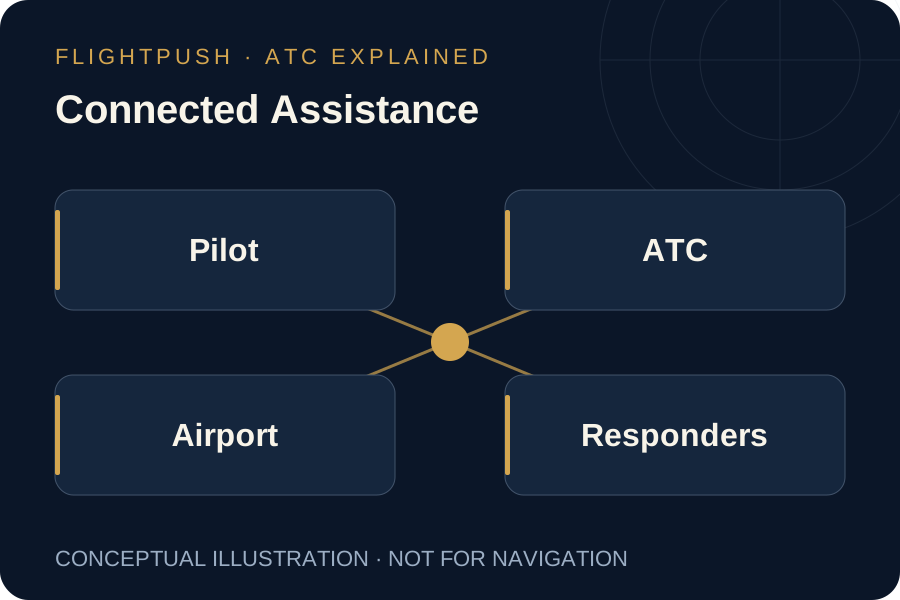
| Participant | Useful Contribution |
|---|---|
| Pilot | Aircraft condition, limitations, intentions, and the assistance needed |
| Controller | Available traffic picture, communications, instructions, and coordination |
| Airport and responders | Relevant ground capability and preparation for the arrival |
| Other aircraft or facilities | Appropriate observations, relays, or support when requested and available |
These roles support one another. No participant automatically knows the entire situation, and the radio should help close the most important gaps.
ATC Can Create Room and Connect Resources
A controller may be able to reduce conflicting traffic, provide appropriate routing assistance, coordinate with another facility, or help arrange an arrival at a suitable airport. The options depend on the actual circumstances and available resources.
A suitable destination is more than the closest airport symbol. Runway characteristics, weather, approach availability, terrain, aircraft capability, and the nature of the problem can affect the choice. The pilot's knowledge of the aircraft needs to be part of that discussion.
A controller's suggestion is therefore valuable information within a shared decision process. It is not proof that every aircraft-specific consideration has been evaluated without the pilot's input.
Communications Problems Need Their Own Response
An aircraft can remain visible to surveillance while the expected radio exchange disappears. A wrong frequency, missed handoff, reception problem, or equipment failure can produce that separation between tracking and voice contact.
JO 7110.65's Communications Failure procedures describe using appropriate available means to restore contact. Emergency frequencies, relays, and other capabilities may form part of the response.
A call heard on guard is not itself proof that the aircraft is in distress. Conversely, a genuine lost-communications problem cannot be resolved by assuming every missing reply was just an innocent tuning error. The actual evidence and applicable procedures matter.
A Diversion Changes More Than the Destination Name
Changing the destination can affect route, altitude, fuel planning, weather suitability, and the services needed on the ground. If the problem involves a medical need or aircraft condition, the receiving airport may need advance coordination.
The earlier route should not remain the default merely because it was already programmed. But a new destination also needs a clear authorization and workable plan under the applicable operation. The participants need the same understanding of where the aircraft is going next.
As the situation develops, an apparently suitable option may change. Weather can deteriorate, the aircraft's capability can reduce, or new information can make another choice better. Reassessment is part of the assistance, not an admission that the first plan was pointless.
Simplicity Is an Operational Advantage
A clear, manageable instruction can be more useful than a theoretically elegant plan that overwhelms the cockpit. The pilot should communicate limitations in workload or capability so the controller can understand what is feasible.
Similarly, concise and accurate updates help ATC maintain a useful picture. Unnecessary detail can wait when it does not affect the immediate decision. This is different from withholding information that changes the risk or the response needed.
The common aim is a plan the aircraft can actually execute, with enough margin and coordination to reach an appropriate outcome.
Asking for Help Is Part of Managing the Flight
An abnormal situation is not improved by preserving the appearance of self-sufficiency. Early, accurate communication can create options before the situation becomes more difficult to manage.
The relationship between pilot and ATC is especially visible here: the pilot brings the aircraft-specific reality, while the controller brings information and coordination from the surrounding system. The response becomes stronger when those perspectives are connected clearly and repeatedly as conditions change.