
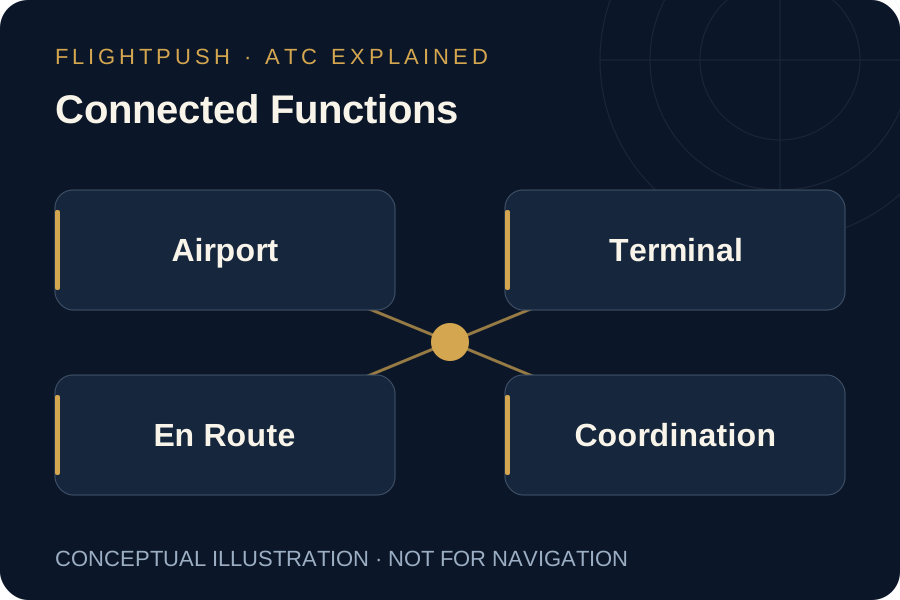
A single flight may speak with clearance delivery, ground, tower, departure, one or more Centers, approach, and another tower. Those voices can sound like separate businesses handing the airplane along. They are parts of an interconnected system, with responsibilities organized around the operation and the airspace.
The system becomes easier to follow when the functions are separated from the buildings and radio names. A function can be combined with another position during a quiet period, divided during a busy one, or provided through arrangements that do not match the airport name printed on a ticket.
Begin With the Function, Not the Room
Clearance delivery, ground control, and local control are familiar terminal functions. Clearance delivery communicates IFR clearance information. Ground control manages authorized surface movements within its responsibility. Local control works with runway operations and the traffic it is responsible for around the airport.
Those descriptions are a starting point, not a guarantee that every airport has each position separately staffed. An operating tower may combine functions, while some airports have no operating tower at all. Published information and actual instructions determine how the pilot uses the services available.
The AIM's Services Available to Pilots section explains the range of services in the system. The existence of ATC as a national network does not mean every location or aircraft receives the same service.
Tower and Terminal Radar See Different Problems
A tower's responsibilities are closely connected with its airport and local traffic environment. A terminal radar facility works with a wider area that may include several airports and multiple arrival and departure paths. These perspectives overlap through coordination rather than becoming identical.
A runway change, for example, is more than a new number in a tower transmission. It may alter arrival positioning, departure paths, and the way terminal traffic connects with neighboring airspace. Changes near the surface can therefore require planning well beyond the airport fence.
The name used on the radio may identify a regional facility rather than the airport itself. That is why hearing a different geographic name after departure is not, by itself, evidence that the aircraft has already entered a distant part of the system.
Approach and Departure Are Functions
Approach control and departure control describe the work being performed for arriving and departing traffic. The services can be provided by the same broader terminal facility, with positions configured to meet the situation.
The AIM's Departure Control discussion describes one part of that arrangement. It helps explain why the transition from tower to departure is not simply the airplane leaving one airport employee and finding a completely independent organization.
At busy times, one flow may need several positions. At quieter times, a single controller may work more than one frequency or function. The number of different voices heard is therefore not a reliable measure of the number of aircraft or facilities involved.
Centers Organize the En Route Picture
Air route traffic control centers provide en route services across their areas of responsibility. Within a Center, sectors divide the work into manageable portions. Sector boundaries and responsibilities connect with neighboring sectors and terminal facilities through established coordination.
A long flight can pass through multiple sectors without the passenger noticing any change. For the pilot, the frequency changes are visible. For the system, each transfer is one part of maintaining continuity across a much larger route.
The aircraft does not become a new flight at each boundary. Its clearance, planned path, identification, and restrictions have to remain understandable to the participants taking responsibility for the next part.
Transfer Is More Than Changing a Frequency
| Layer | What Has to Continue Working |
|---|---|
| Pilot communication | The aircraft knows which frequency and facility to use |
| Controller coordination | The next position has the information and agreement it needs |
| Flight path | Route and altitude remain compatible with the surrounding operation |
| Monitoring | The aircraft's progress and any changing problem remain visible to the appropriate participants |
A pilot hears the transfer instruction, but not necessarily the coordination that preceded it. Conversely, hearing a new callsign on a frequency does not reveal every detail of control responsibility or any agreement between the positions.
Thinking in layers prevents a common misunderstanding: radio communication, radar identification, and responsibility for a particular service are related, but they are not the same fact.
Safety Priorities Connect the Pieces
JO 7110.65's Duty Priority guidance gives first priority to separating aircraft and issuing safety alerts. Those priorities help explain why a controller may pause a routine request while addressing a developing conflict or an immediate safety issue.
Efficiency still matters. Routes, sequencing, staffing configurations, and traffic-management initiatives aim to use the available system well. But an efficient plan must remain workable under the applicable safety requirements and actual conditions.
The system also includes participants outside the controller positions a pilot normally calls: traffic-management personnel, technical support, airport operators, weather providers, and other operational organizations. Their work affects what the controller can offer at a particular moment.
Why There Is No Single Controller's View
Imagine an arrival approaching a busy airport while departures are climbing through the terminal area. The tower is concerned with runway use, the terminal positions with crossing flows and arrival order, and an en route sector with the aircraft it is feeding toward the airport. A traffic-management function may be looking farther ahead still.
None of these views is pointless duplication. They solve different parts of the same flight. Coordination is what keeps a locally useful action from creating an unworkable problem for the next participant.
Understanding those roles makes ordinary radio exchanges more informative. “Contact departure” becomes a transition between connected functions, and a delay becomes a question about where the constraint sits rather than an assumption that the nearest controller is the entire system.