
A departure delay can begin at an airport where the runway is open, the weather is clear, and only a few aircraft are visible outside. That feels contradictory until the flight is viewed as a demand on several connected parts of the system, including places it has not reached yet.
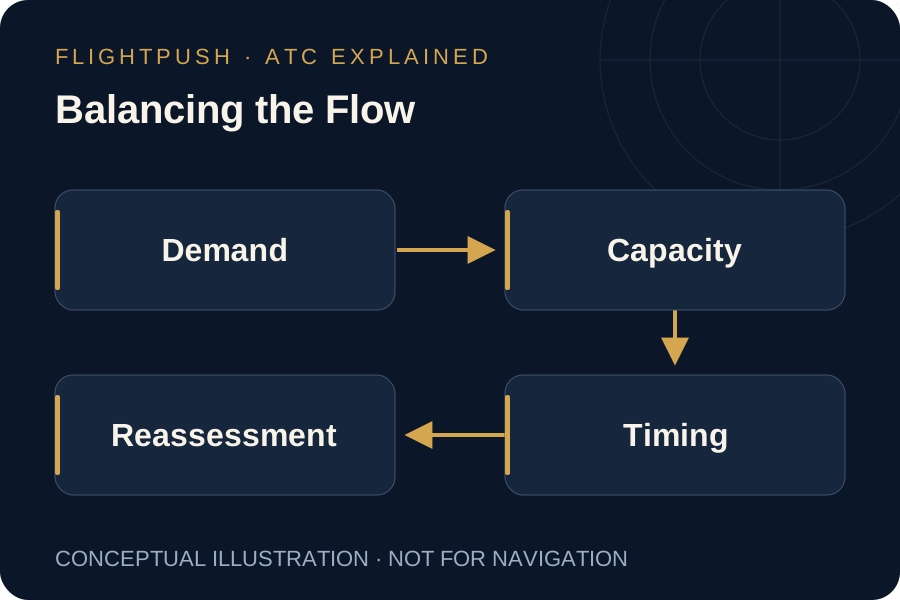
Traffic management works with that larger picture. Its purpose is to match the flow of aircraft with usable capacity, while controllers continue the tactical work of separating and moving the traffic already in their areas. A delay is often the point where those two planning scales become visible to the passenger.
Demand and Capacity Do Not Always Match
Demand is the traffic that wants to use a runway, route, airport, or sector during a period. Capacity is what that part of the system can safely and practically accommodate under the actual conditions. Neither is fixed for the entire day.
Weather, runway configuration, equipment limitations, staffing arrangements, airspace availability, and the mix of aircraft can all influence the operation. A route may be available on a chart while being constrained for the volume or timing of traffic that wants to use it.
JO 7110.65's Traffic Management Duty Responsibility guidance places this work within the controller system. It is a different planning function from simply giving the next aircraft a heading, although the two activities must remain connected.
The Constraint May Be Far Ahead
An aircraft departing one airport may be headed toward a constrained arrival stream several states away. Launching it immediately would add demand to that future problem, even if the local departure path is currently clear.
A similar issue can occur along an en route corridor. If weather leaves only a limited set of usable paths, many otherwise independent flights may need the same remaining airspace. The system has to account for where the traffic will converge, not only where it starts.
This is why looking out the window is not enough to identify the cause of a delay. The relevant queue may exist in time and planned routes rather than as a visible line of aircraft beside the runway.
Different Initiatives Address Different Problems
| General Tool | What It Can Help Manage |
|---|---|
| A ground stop | Holding affected departures while a constraint is assessed or managed |
| A ground delay program | Managing the timing of affected arrivals through assigned departure planning |
| Rerouting | Moving traffic away from constrained routes or areas |
| Spacing restrictions | Regulating how closely a flow is delivered to another part of the system |
The exact initiative, affected flights, and instructions determine what applies. These tools are not interchangeable labels for every late flight, and the existence of one does not explain every delay at the airport.
A useful explanation identifies the affected resource and the type of restriction rather than treating “ATC delay” as a complete diagnosis.
A Time Is Not Every Kind of Permission
The AIM's Departure Restrictions discussion distinguishes concepts such as hold for release, release times, and clearance void times. Their meanings matter because they constrain when an aircraft may act under the applicable clearance.
An expected time or an assigned traffic-management time does not replace a required takeoff clearance, departure release, or any other authorization that applies to the operation. The pilot and operator must understand the specific instruction rather than assuming that all timing messages do the same job.
For an observer, this explains why reaching a scheduled time does not always cause the airplane to move immediately. Several necessary conditions may still have to align, including the local runway situation.
Local Controllers Still Need a Workable Sequence
Traffic-management planning does not remove the tower's need to manage arrivals, departures, crossings, and wake requirements. Nor does it remove the departure controller's need to fit an aircraft among the traffic already airborne.
A planned release has to become an actual movement that works locally. If an aircraft cannot be ready at the necessary time or a new constraint appears, coordination may be required to revise the plan.
JO 7110.65's Traffic Management Duties and Responsibilities describe how that function connects with operational facilities. The result is a coordinated process, not a timer acting independently of the runway and airspace.
Why Ground Waiting Can Be Preferable
An aircraft waiting on the ground generally preserves options that become harder to manage after departure. Airborne holding consumes fuel and occupies airspace; a crowded arrival area leaves fewer useful choices when conditions worsen.
That does not mean every ground delay is automatically optimal or that airborne holding can always be avoided. It explains the planning reason for managing some demand before it reaches the constrained area.
The choice also has consequences for crews, operators, and passengers. An effective system has to reassess those consequences as the constraint changes rather than treating the original plan as permanent.
The Plan Can Change During the Wait
A forecast improvement may be delayed, a runway may reopen, a route may become usable again, or demand may shift. New information can shorten, extend, or otherwise change the restriction affecting a flight.
A revised time is therefore not automatically evidence that the previous information was meaningless. It may reflect a genuine change in the conditions or the best available forecast. At the same time, the operational participants need timely updates so they can make useful decisions about readiness and alternatives.
There is also no universal sequence in which every waiting aircraft must depart. Routes, destinations, readiness, applicable priorities, and specific restrictions can produce different outcomes for aircraft sitting near each other.
The Useful Question Is Where the Bottleneck Is
A delay becomes more understandable when the resource, time window, and affected flow are identified. The departure runway might be the bottleneck, but so might the destination arrival rate or a corridor hundreds of miles away.
Traffic management connects those constraints with the flights that would otherwise arrive at the wrong place or time. The wait is visible at the gate or holding point; the problem it is intended to manage may be much farther along the journey.