
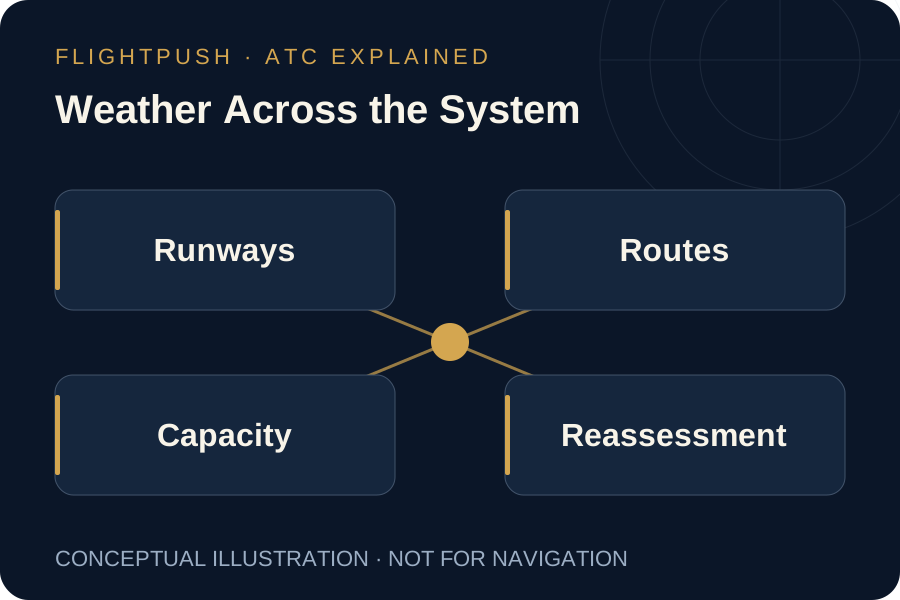
Weather changes more than the comfort of a flight. It can alter the runway an airport uses, the routes aircraft can accept, the amount of spacing needed, and the number of aircraft that can move through an area. A thunderstorm far from the departure airport can therefore become a departure problem there.
The connection is capacity: the system has to compare the demand for routes and runways with what can be used safely under the conditions that exist. ATC's tactical instructions and broader traffic-management plans are different ways of responding to that changing balance.
Weather Affects the Shape of the Operation
Wind can influence runway configuration. Low visibility can change how an airport conducts surface and approach operations. Convective weather can make a previously useful route unacceptable to the aircraft that would have used it.
These effects can occur together. A runway change may require arrivals to be repositioned while departures need new routes. Aircraft avoiding a line of storms can concentrate traffic in the remaining usable airspace.
The AIM's Use of Aviation Weather Products guidance provides context for interpreting weather information. A report, forecast, radar image, and pilot report answer different questions, and their limitations matter to both planning and real-time decisions.
A Display Is Not the Weather Itself
Weather information is an observation or representation of conditions, produced through a particular system. It may not show every hazard or the condition at the exact place and time an aircraft will encounter it. Age, coverage, resolution, and the kind of product all affect its use.
ATC precipitation displays do not establish the presence or absence of clouds. The intensity of a precipitation return also does not, by itself, identify whether the material is rain, snow, hail, or another type.
A controller's weather display and a cockpit weather display can therefore differ without either showing the complete situation. A gap that looks attractive on a screen is not, by itself, proof of a safe passage through developing convection.
The AIM's ATC Inflight Weather Avoidance Assistance discussion explains the assistance ATC can provide and the limitations involved. Aircraft capability and the pilot's assessment remain important parts of the decision.
Tactical Changes Work One Flight at a Time
A pilot may request a deviation, a different altitude, or another destination. The controller considers the request in the context of traffic, airspace, and the services being provided, then coordinates or offers an alternative as appropriate.
A useful request describes the operational need. The direction or extent of a deviation, a limitation on altitude, or an inability to continue the current route gives ATC something concrete to work with. A late or ambiguous request leaves less time to fit the change around other traffic.
An approval must still be understood as a clearance with a defined scope. Permission to deviate in one dimension should not be treated as permission to change every other part of the flight independently.
The Remaining Routes Have Limits Too
| Weather Effect | Possible Operational Consequence |
|---|---|
| A blocked arrival route | Aircraft need a different route or a changed arrival rate |
| A runway configuration change | Arrival and departure paths need to be adjusted |
| Reduced visibility or surface capability | Runway and taxi operations may require a different plan |
| Widespread deviations | Traffic concentrates in the routes and sectors still usable |
The alternative route that works for one aircraft may become crowded when many flights need it. Sending every airplane around the same side of a storm does not create unlimited room there.
This is where local weather avoidance and system-level demand management meet. The next sector must be able to receive the changed flow, and the destination must still be able to handle the arrivals.
Traffic Management Looks Farther Ahead
JO 7110.65's Traffic Management responsibilities connect operational demand with the capacity of the system. Tactical separation remains necessary, while broader planning can limit how much demand reaches a constrained place at once.
That can mean an aircraft waits on the ground even though the departure runway is clear and the local weather is good. The constraint may be the destination, an en route corridor, or an area many miles ahead.
A ground delay can preserve more options than an overloaded airborne arrival stream. It does not eliminate the inconvenience, but it explains why a delay can be part of protecting a workable plan rather than evidence that someone has forgotten the flight.
Forecasts Make Planning Necessary, Not Certain
Weather can develop differently from the forecast. A predicted improvement may arrive late; a storm may grow faster than expected; an initially manageable route may become unsuitable after several aircraft have already departed.
A useful plan therefore needs reassessment. Traffic-management restrictions can be changed, extended, or removed as conditions and available capacity change. Pilots and operators also need to revisit fuel, alternates, timing, and the suitability of continuing.
The fact that an earlier plan was reasonable does not prove it remains reasonable. Likewise, a change in plan is not automatically evidence that the original decision was careless. The information and constraints can genuinely evolve.
Communication Preserves Options
Early reports of conditions, inability to comply, or a need to divert help the controller understand the aircraft's real situation. The distinction between inconvenience and a developing safety problem should be communicated clearly, including urgency when it exists.
A pilot should not continue into conditions beyond the aircraft's or pilot's capability simply because the original clearance points that way. The actual problem needs to be stated so a suitable response can be developed.
For the controller, each change also has a downstream effect. A turn to avoid weather can affect neighboring traffic, receiving sectors, or the arrival sequence, which is why coordination remains central even during a very local-looking problem.
Weather Connects the Whole Flight
The departure airport, en route path, destination, and possible alternates form one operational picture. Weather can constrain any part of it, and ATC has to help manage the resulting movements without assuming that every aircraft has the same capability or options.
This explains how a distant storm becomes a local wait, how a small deviation becomes a wider routing change, and why the latest usable information matters more than whether the sky above the terminal happens to look clear.