
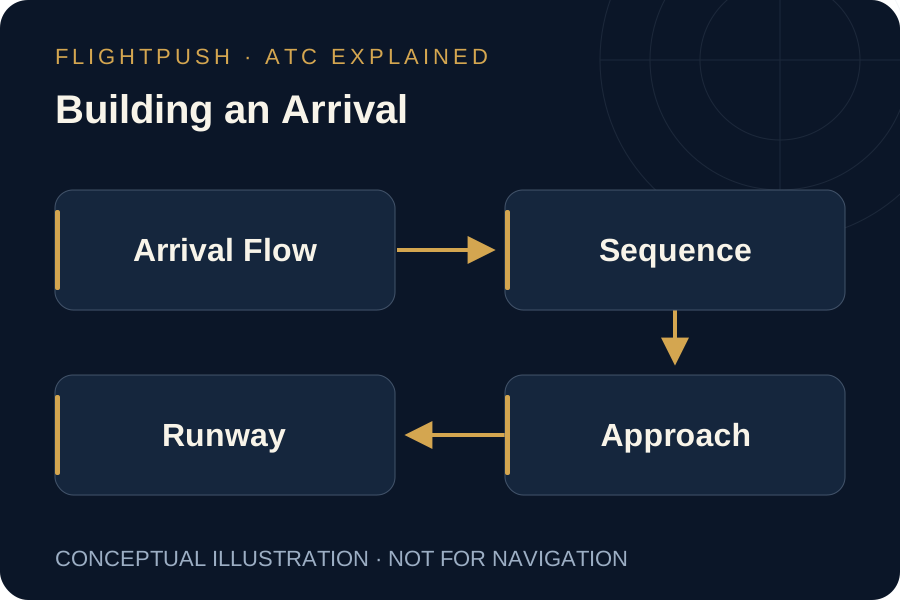
An arrival starts long before an airplane turns onto final approach. Aircraft approach an airport from different directions, at different speeds and altitudes, while the runway can accept only a workable sequence. The controller's task is to turn those separate flights into an orderly flow without losing sight of the limits and needs of each aircraft.
That process connects arrival routes, descent planning, speed adjustments, radar vectors, approach clearances, and runway operations. Understanding the whole chain explains why the final minutes of a flight can change even when the destination remains the same.
The Arrival Plan Begins Upstream
En route and terminal facilities coordinate how aircraft will enter the destination area. Published arrivals and other routes can make those transitions more predictable, but a charted route is not a promise that the exact path will be flown unchanged.
Weather, runway configuration, equipment availability, and traffic can all influence the plan. A change at the airport can propagate upstream because aircraft need time and distance to adjust their descent and position.
The AIM's Standard Terminal Arrival discussion explains how a STAR connects the en route environment with the terminal area. A route clearance, a descent authorization, and an approach clearance remain distinct parts of the operation.
A Sequence Has to Work in Three Dimensions
Two aircraft can be far apart laterally but create a problem as their paths converge. They can also be close on a map but separated vertically under the applicable criteria. The controller needs to consider where each aircraft will be, not only its current symbol.
Differences in speed matter as well. A faster aircraft following a slower one can reduce the available spacing. A sequence that looks comfortable at one moment may need adjustment before the aircraft reach final approach.
This is why arrival management includes planning ahead. Waiting until every aircraft reaches the same turn point would leave fewer useful options for organizing the traffic safely and efficiently.
Speed and Distance Are Complementary Tools
Speed instructions can help control how quickly one aircraft gains on another. Vectors can change distance remaining, position an aircraft for an intercept, or create a more suitable joining angle. Neither tool is unlimited: aircraft performance, procedures, weather, and available airspace constrain the choices.
| Tool | What It Can Help Manage |
|---|---|
| Published arrival routing | Predictable entry paths and common planning points |
| Speed instructions | Relative progress and closure within a sequence |
| Radar vectors | Position, spacing, and alignment for the next segment |
| Holding or upstream restrictions | Demand that cannot yet be accommodated near the airport |
A pilot's early report that a speed or configuration cannot be achieved gives the controller a more useful planning picture. An apparently small limitation can affect where the aircraft fits among the others.
Vectors Are Part of a Route Plan
JO 7110.65's Vectoring Application guidance describes the conditions and purposes for vectoring. During an arrival, headings can help establish a workable approach sequence rather than simply shortening the route.
The pilot still needs to distinguish the heading assigned now from an expected later route. A turn toward the airport does not independently authorize descent or clear the aircraft for an approach. An aircraft should not leave a heading merely because the moving map shows a convenient shortcut.
The next clearance connects the vector with the intended route or procedure. That connection matters both for the pilot's navigation and for the controller's expectations about where the aircraft will go.
An Approach Clearance Has a Defined Meaning
An instrument approach provides published navigation and associated requirements for reaching the runway environment. The clearance must be understood together with the aircraft's position, altitude instructions, and the procedure being flown.
The AIM's Instrument Approach Procedure Charts guidance explains the charted framework. The pilot needs the current appropriate procedure and a clear understanding of the clearance; familiar airport scenery is not a substitute for either.
A visual approach and an instrument approach are not interchangeable just because the pilot can see some part of the airport area. Each has its own requirements and responsibilities. Similarly, an approach clearance is not itself a landing clearance at an airport where a separate landing clearance is required.
The Runway Remains a Constraint
The tower works with arrivals, departures, crossings, runway occupancy, and other movements. The arrival sequence has to fit that actual runway operation, not merely produce evenly spaced symbols on a radar display.
Wake-turbulence considerations can affect the usable spacing between particular aircraft. A runway exit that becomes unavailable, a slower-than-expected runway vacation, or a missed approach can change the immediate plan. Those changes can require action by both tower and approach control.
This is one reason the sequence continues to be monitored after an aircraft is established on final. Being lined up does not mean all the remaining decisions have been completed.
A Go-Around Rejoins the System
A go-around can result from an unstable approach, runway conditions, traffic, an ATC instruction, or another reason the landing should not continue. The pilot's first task is aircraft control and the applicable aircraft procedure, followed by the communication and coordination the situation permits.
For ATC, the aircraft is now a moving participant that must fit with other traffic and the applicable missed-approach or amended instructions. The outcome can affect aircraft behind it and departures waiting on the ground.
A go-around is therefore an anticipated part of planning, not proof that the whole system has failed. The important question is whether the pilot and controller understand the next path and restrictions.
The Arrival Is a Continuous Coordination Problem
From the upstream arrival flow to the runway exit, each stage depends on the stages around it. Published procedures create a common framework; tactical instructions adapt that framework to the conditions that exist now.
For a reader listening to approach control, this makes a heading, speed assignment, or extended final easier to interpret. It is one adjustment within a shared sequence, not necessarily a judgment about how quickly one individual pilot should reach the runway.