
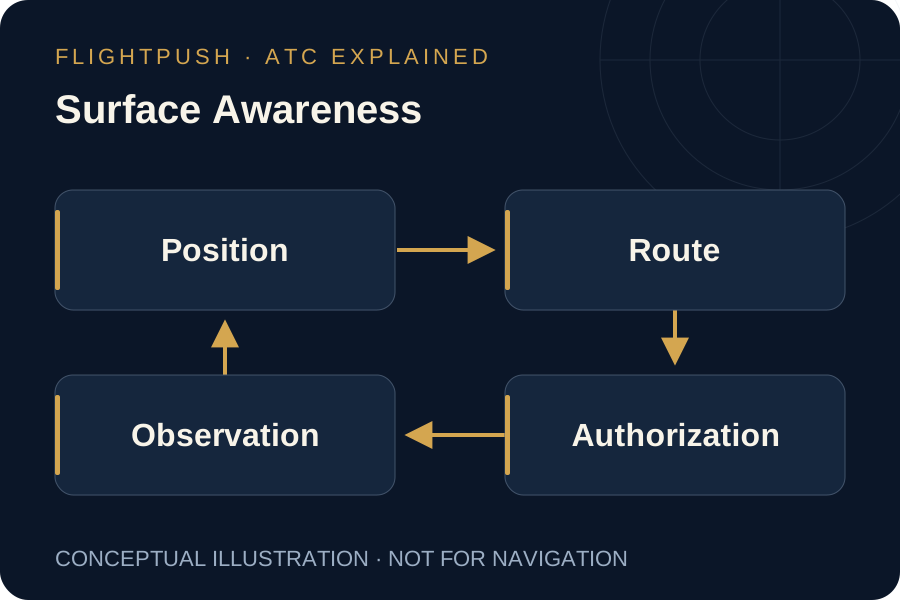
The airport surface is a traffic system in its own right. Departures need a route to the runway, arrivals need a way to leave it, vehicles may need to cross it, and some movements cannot occur at the same time. The diagram's lines are fixed, but the permissions and conflicts are constantly changing.
ATC manages part of that environment through clear instructions and coordination. Pilots contribute by knowing their position, understanding the authorization received, and matching the radio exchange with the signs and markings outside. Neither the diagram nor the clearance works well in isolation.
Know Where the Operation Begins
Before taxiing, a pilot needs the current airport information and an accurate starting position. Similar-looking intersections, construction, unfamiliar ramps, and changes from a usual runway can all undermine a route remembered from a previous visit.
At an airport with an operating control tower, movement-area and runway authorizations have particular meanings. Nontowered operations have different communication and responsibility arrangements. A call on an advisory frequency does not become an ATC clearance merely because other aircraft can hear it.
The AIM's Taxiing guidance explains the towered-airport procedures that frame many of these exchanges. The operating context needs to be established before a phrase is interpreted.
Ground and Runway Functions Must Connect
A taxi instruction can take an aircraft toward a runway without authorizing it to enter that runway. The controller responsible for a runway operation must also account for arrivals, departures, crossings, and other applicable constraints.
That requires coordination between the functions working the aircraft. Some positions may be combined, but the underlying conflicts do not disappear because one person is working more than one frequency.
JO 7110.65's Taxi and Ground Movement Operations procedures describe the controller-side framework. From the cockpit, the practical result is a route and a set of permissions that must be understood precisely.
Route, Crossing, and Takeoff Are Different Authorizations
| Instruction | What Must Not Be Assumed |
|---|---|
| Taxi toward an assigned runway | Permission to enter or cross that departure runway |
| Hold short of a runway | Permission to continue because the runway looks empty |
| Cross a specified runway | Permission to cross every runway farther along the route |
| Line up and wait | A takeoff clearance |
| Cleared for takeoff | Proof that every aircraft-specific performance concern has been resolved by ATC |
The route describes where the aircraft is to go within the actual authorizations and restrictions. A taxiway continuing across a runway on the diagram does not supply an omitted crossing clearance.
This distinction matters even when another aircraft has just made the same movement. That aircraft's authorization belongs to it, not to every aircraft following behind.
The Physical Airport Confirms the Position
Signs, markings, lighting, and the diagram provide complementary information. A holding-position marking identifies a boundary the pilot must recognize in the actual environment. The diagram helps explain where that boundary sits within the larger layout.
The AIM's Airport Marking Aids and Signs guidance describes these cues. Their value depends on looking outside and connecting the observed identifier with the route and clearance, not merely knowing what the symbols mean in a classroom.
A charted hot spot deserves particular attention, but an unmarked intersection still requires awareness. The absence of a warning symbol does not establish that a location cannot produce a navigation mistake or conflict.
Readbacks and Position Checks Solve Different Problems
A readback allows the controller to hear what the pilot understood. Runway hold-short instructions require particular attention. But a pilot can repeat the correct runway designation while physically approaching a different intersection.
A deliberate position check connects the words with the aircraft's real location. Before a runway entry or crossing, the pilot needs to understand the authorization and identify the relevant runway and holding position. Looking for other traffic remains important as well.
If uncertainty develops, clarification while safely clear is preferable to continuing on a guessed interpretation. Progressive taxi instructions can help when the route is unfamiliar or difficult to identify. If an immediate hazard already exists, prompt communication and necessary safety action take priority over a routine exchange.
Arrival Handling Continues After Touchdown
An arriving aircraft occupies the runway until it has safely left the runway environment as required. Its exit affects the next arrival, a departure waiting to enter, and any planned crossing. A slower-than-expected runway vacation can therefore change more than one controller's immediate plan.
The pilot should not stop on the runway to complete an after-landing checklist or change frequencies. The entire aircraft must be beyond the applicable holding-position marking before treating the runway as clear. Subsequent taxi instructions then establish the onward route.
A familiar destination ramp can still require a different route because of construction or the runway configuration. The end of the flight deserves the same route awareness as the beginning.
Conditions Can Reduce the Available Margin
Low visibility, darkness, wet pavement, construction, and radio congestion can make a simple surface movement more demanding. A pilot may have less time to recognize a sign, more difficulty identifying a turn, or an increased need to divide attention between the cockpit and outside.
The appropriate response is to preserve awareness and communicate uncertainty, not to maintain a normal taxi pace at the expense of understanding. The controller also needs accurate position and capability information to manage the traffic well.
Surface safety depends on several defenses working together: a suitable route, an unambiguous instruction, a correct readback, accurate position awareness, and continued observation. No one of those defenses makes the others optional.
Think of Taxiing as Part of the Flight
A runway incursion risk can develop before takeoff or after landing. The surface is therefore not a low-attention interval between the important flying tasks. It is an operation with changing permissions and potentially serious conflicts.
When the pilot and controller share a clear understanding of position, route, and authorization, the diagram becomes a practical tool rather than a picture, and a short clearance becomes a reliable part of the movement rather than something to interpret after the turn.