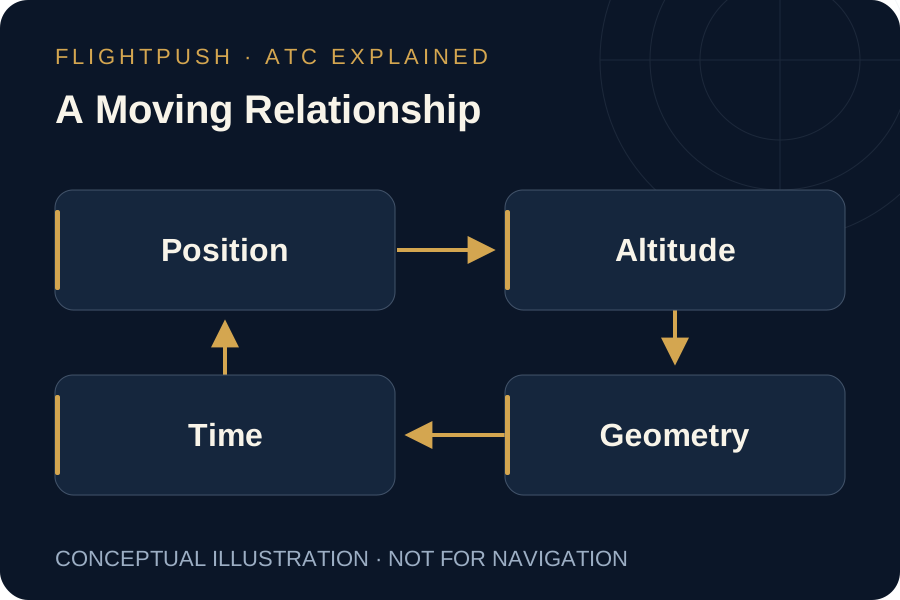
Two aircraft can look close through a cabin window while being properly separated, or look comfortably apart on a map while their future paths are converging. Air traffic control is concerned with the applicable relationship between the aircraft over time, not simply how much empty sky a passenger can see.
Separation is therefore best understood as a set of methods applied under defined conditions. Surveillance, altitude, route, timing, visual procedures, runway use, and wake turbulence all contribute to the picture. No single distance describes every situation.
Begin With the Service Being Provided
The requirements depend on the aircraft's operation, airspace, and service. An IFR aircraft receiving separation services is not in the same procedural situation as every VFR aircraft receiving traffic information. The controller's display can include both without making the service identical.
JO 7110.65's ATC Service guidance establishes the broader framework. It is important to identify what service and rules apply before trying to infer the meaning of a particular distance between targets.
The pilot's responsibilities also continue under applicable rules. ATC service is not a general guarantee that every hazard, aircraft, or operating limitation has become somebody else's concern.
Separate Current Position From Future Conflict
A controller must consider where aircraft are going as well as where they are now. Direction, speed, altitude, planned turns, and clearances influence the future relationship. Two targets maintaining distance on one heading may begin closing after a turn.
That is why a heading or altitude instruction can be useful before the reason looks obvious to a cockpit observer. The instruction may prevent a problem that would otherwise develop several minutes later.
It also explains why a controller needs early notice of a limitation. If an aircraft cannot achieve an assigned altitude or speed, a plan built on that expectation needs revision rather than a late discovery that the spacing has changed.
Different Methods Solve Different Problems
| Method or Consideration | What It Helps Establish |
|---|---|
| Vertical separation | An acceptable altitude relationship under the applicable criteria |
| Surveillance-based separation | A qualifying relationship between identified aircraft using approved surveillance procedures |
| Route or procedural separation | Separation based on defined routes, positions, timing, or other procedural conditions |
| Authorized visual separation | A specified visual-separation arrangement with its own conditions and responsibilities |
| Runway and wake requirements | Additional constraints connected with the surface operation or an aircraft's wake |
These are not a menu from which an observer can choose the most convenient answer. Each method has conditions, and transitions between methods must preserve the required separation.
Why There Is No Universal Radar Distance
JO 7110.65's Surveillance Separation Minima contain different applications and conditions. The appropriate minimum can depend on the surveillance system, location, operation, and other requirements.
A familiar number heard in a lesson should therefore be connected with its application. Repeating a single distance without the conditions can make an explanation simpler while making it less accurate.
The same caution applies to looking at a flight-tracking website. Public displays may simplify, delay, or interpolate positions. They are not the operational display, complete clearance history, or procedural evidence needed to judge whether a particular encounter complied with the applicable standard.
Wake Turbulence Adds Another Relationship
An aircraft leaves a wake that can affect another aircraft's controllability. The relevant procedures consider more than the distance between two current position symbols. Aircraft characteristics, relative paths, and the type of operation can matter.
JO 7110.65's Wake Turbulence guidance connects the wake requirements with the procedures for particular situations. A controller may need spacing that differs from what would otherwise be usable for a traffic sequence.
For pilots, an apparently wide runway or a clear view of the preceding airplane does not by itself settle the wake question. Current aircraft guidance, ATC instructions, and the applicable pilot responsibilities remain relevant.
A Traffic Advisory Is Not Every Kind of Separation
A traffic call tells the pilot about another aircraft that warrants attention. It can be extremely useful without establishing that ATC is providing the same separation service that applies in another class of airspace or under another set of operating rules.
Seeing the reported traffic is also distinct from being instructed and authorized to maintain visual separation under the applicable procedures. The words, circumstances, and responsibilities matter. An informal assumption should not replace that understanding.
This distinction is particularly useful when moving between training environments. A student who has mostly heard IFR traffic may otherwise interpret a VFR advisory as a promise that the controller will keep every nearby aircraft apart in the same way.
Controllers Use Several Tools Together
A controller can change geometry with a vector, change the vertical relationship with an altitude instruction, or manage closure with speed instructions. The choice must fit the applicable rules and the available operational room.
For example, a conceptual crossing conflict might be resolved by keeping one aircraft at an appropriate different altitude until the paths no longer require that arrangement. Another situation may be better managed by a turn or a changed sequence. The existence of several tools does not mean all are available for every aircraft or location.
Pilot capability, terrain, weather, neighboring airspace, and coordination with the next sector can limit the choices. A locally simple instruction must still work in that wider environment.
The Important Question Is the Applicable Relationship
Separation explanations become useful when they identify the operation, method, conditions, and responsibilities. The number, when one applies, belongs inside that explanation rather than standing alone as the entire rule.
That perspective makes a controller's early intervention easier to understand. It is a way to maintain a defined safe relationship as the traffic moves, not merely a response to two symbols looking too close at the moment someone happens to watch them.