
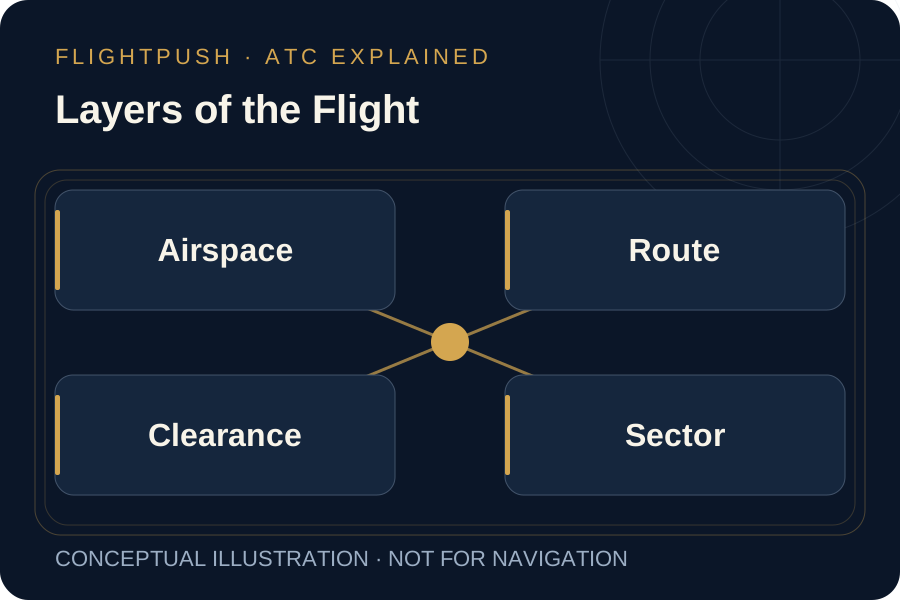
The sky looks continuous, but the aviation system divides its use through airspace classes, published routes, procedures, sectors, and temporary restrictions. These layers answer different questions. Confusing them can make a chart seem contradictory or make a radio instruction appear to grant more permission than it does.
A useful picture begins with three ideas: airspace describes an operating environment, routes organize intended paths, and sectors divide controller responsibility. Aircraft move through all three layers, often while weather and traffic are changing what is practical.
Airspace Classes Establish an Operating Framework
The U.S. system includes controlled Classes A, B, C, D, and E, and uncontrolled Class G. The applicable class helps determine requirements for entry, communications, equipment, weather, and the service relevant to the operation.
The AIM's Controlled Airspace section explains those distinctions for Classes A through E. “Controlled” does not mean every aircraft receives the same instruction or separation service. “Uncontrolled” does not mean unrestricted, unregulated, or empty.
The aircraft's actual position and altitude matter. Controlled airspace may extend to the surface or begin at a higher floor. A statement about the airspace above an airport is incomplete if it does not establish where the proposed flight would operate within that structure.
Published Routes Organize Movement
A route connects points in a way that supports navigation and traffic planning. Departures, arrivals, airways, and other cleared route segments can create predictable paths for aircraft with different origins and destinations.
The route is not the same thing as the surrounding airspace class. Two aircraft can occupy the same broad class while following very different clearances, and a route can pass through several operating environments.
Published procedures also do not act as automatic permission. A pilot needs the applicable clearance or authorization, current procedure, and aircraft capability for the operation. A line drawn on a chart describes information; it does not, by itself, establish that the flight may follow it now.
Sectors Divide the Controller's Work
A sector is a portion of the operation assigned for controller responsibility. Its boundaries help organize traffic and coordination. Sector configurations can be combined or divided as conditions and demand require, rather than remaining identical to every charted airspace class boundary.
That is why a frequency change may occur without an obvious landmark outside. The aircraft is crossing an operational boundary in the controller system, not necessarily a boundary that the passenger can identify from the ground below.
| Layer | The Main Question It Helps Answer |
|---|---|
| Airspace class | Which operating requirements and services apply here? |
| Published route or procedure | What path and associated requirements describe this segment? |
| Clearance | What has this aircraft actually been authorized to do? |
| Sector or facility responsibility | Which part of ATC is handling the relevant work now? |
These layers connect but do not replace one another. Being in communication with one sector does not create universal authorization for every airspace or route nearby.
Special-Use and Other Restrictions Add Context
The AIM's Airspace discussion distinguishes the broader categories that exist alongside the basic class structure. Special-use airspace and other designated areas require attention to their specific meaning, status, and applicable rules.
The exact type matters. It would be inaccurate to explain every charted special-use area as either completely forbidden or automatically available. Time, activity, authorization, and the operation can all influence what applies.
Temporary restrictions and relevant notices add another time-sensitive layer. A chart is an essential planning tool, but current operating information is also needed to understand whether the intended flight remains appropriate and authorized.
Flows Connect the Layers
Arriving and departing aircraft often use organized paths through the terminal environment. An arrival gate or departure exit can help feed traffic between facilities and sectors. The shape of that flow reflects more than the location of the destination airport.
Runway configuration, terrain, neighboring airports, weather, and the available airspace influence the useful paths. A route that looks longer on a map may fit those constraints better than a direct line across several crossing flows.
The result is a system of connections, not a set of unrelated boundaries. A change to one arrival route can affect sector demand, departure options, or the traffic delivered to the next facility.
Vectors Adapt the Published Plan
JO 7110.65's Vectoring Application guidance describes how headings can be used under defined conditions. Vectors provide a way to adjust geometry without requiring every tactical movement to follow the original published route unchanged.
The controller must still account for the applicable jurisdiction, minimum-altitude framework, and other procedural conditions. A vector is an operational tool within the system, not permission to disregard its structure.
For the pilot, the latest instruction needs to be understood together with the other elements of the clearance. A heading does not independently supply a new altitude, and an expected return to a route is not the same as an instruction authorizing it.
A Constraint Can Move the Problem Elsewhere
Suppose weather makes one corridor unusable. Traffic may need another corridor, but that alternative lies within sectors that already have demand. The issue has moved from weather avoidance for one flight to the capacity of the remaining network.
The same connection can occur when an airport changes runways. Aircraft need different paths, which can change how terminal and en route sectors exchange traffic. An operational adjustment at the airport can therefore require upstream coordination.
Understanding the layers helps explain why the solution is not always simply to turn everyone toward the empty-looking area on a public map. The area may have different responsibilities, restrictions, terrain, or receiving capacity.
Read the Sky as a Connected System
For a student, separating class, route, clearance, and controller responsibility makes charts and radio exchanges easier to interpret. Each layer contributes a different kind of information, and the actual flight has to satisfy the relevant requirements across them.
That broader picture also explains why ATC cannot be understood from the airport alone. The flight is moving through a network of operating environments and agreements, and a change in one part can affect what is possible in another.