
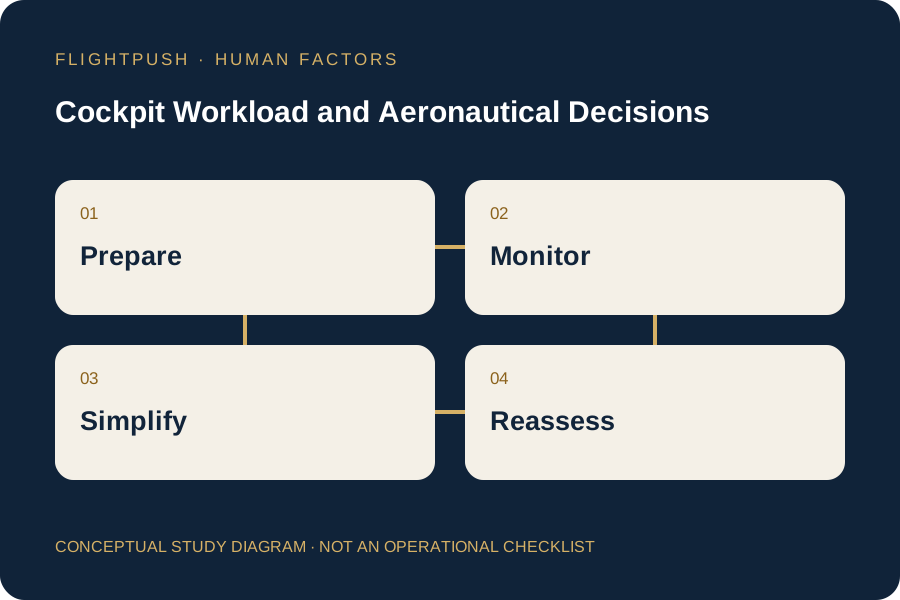
A flight can become difficult without a single dramatic failure. A late runway change, an unfamiliar display, a passenger question, and deteriorating weather can arrive close together. Each task is manageable in isolation, yet together they can consume the attention needed to fly the airplane.
Workload management is the practice of protecting that attention. It begins before departure, continues through task timing and communication, and includes the willingness to simplify or stop a plan when the available capacity no longer matches the demands.
Attention Is a Limited Resource
Pilots cannot give full attention to every display, radio call, checklist item, and outside cue at once. What feels like multitasking is often rapid switching between tasks. Switching has a cost, particularly when the pilot must remember where an interrupted task stopped.
The Risk Management Handbook connects the pilot, aircraft, environment, and external pressures as parts of a developing risk picture. Workload fits that picture because a manageable demand for one pilot on one day may be excessive under different conditions.
Move Work to the Quiet Portions
Review airport information, organize charts, brief expected changes, and configure equipment when attention is available. A task completed carefully before departure is less likely to compete with aircraft control during a busy climb or approach.
Preparation should also include uncertainty. Brief the likely plan and the point at which a different plan becomes necessary. A pilot does not need to predict every change to know how to request time, discontinue an approach, or choose a simpler destination.
Know What Automation Is Actually Doing
Automation can reduce repetitive work, but it introduces mode selection, monitoring, and failure-recognition tasks. Selecting a mode is not the same as confirming that the aircraft is following the intended path.
Cross-check the active modes, target values, and actual aircraft response. If the behavior is unexpected, use an appropriate level of automation consistent with the aircraft's procedures and the pilot's training. Continuing to troubleshoot a complex mode while the flight path deteriorates reverses the purpose of the equipment.
Recognize the Early Signs of Saturation
Missed calls, repeated entries, rushed checklists, fixation on one display, and surprise about the aircraft's position can signal that workload is overtaking capacity. These cues are more useful when treated as reasons to simplify than as evidence of personal failure.
A pilot can create room by delaying a nonessential task, asking for clarification, declining an amendment that cannot be safely accepted, or requesting an available operational alternative. The specific choice depends on the situation; the general principle is to act before confusion becomes a flight-path problem.
Protect Checklists From Interruptions
A checklist supports reliable verification, but only when its use matches the aircraft's procedures and the phase of flight. Reading words without checking the relevant condition provides less protection than it appears to.
When interrupted, resume using the method taught for the operation rather than guessing which items were completed. Distinguish immediate actions required by an abnormal situation from the subsequent checklist verification; generic advice should not invent an emergency sequence for an unfamiliar aircraft.
Make Decisions While Options Are Still Comfortable
| Developing Condition | A Useful Response to Consider Early |
|---|---|
| Unfamiliar arrival | Obtain information and allow time to brief |
| Weather uncertainty | Reassess before the remaining options narrow |
| Automation confusion | Simplify while maintaining aircraft control |
| Fatigue or distraction | Reduce demands or change the plan |
An early diversion can be a routine navigation task. The same decision postponed until weather, fuel, and fatigue worsen may become far more demanding. Timing changes both the risk and the workload of a decision.
External Pressure Often Looks Reasonable
A passenger needs to get home. A rental booking ends soon. The pilot has already spent money on the trip. None of these facts changes aircraft performance or weather, but each can influence how evidence is interpreted.
Separate the consequences of postponing from the conditions required for safe flight. The preflight responsibilities in 14 CFR 91.103 establish preparation obligations, while the pilot's continuing judgment must respond to what actually develops after departure.
Debrief the Process, Not Just the Outcome
Arriving safely does not prove every decision was sound. Ask which assumptions held, which tasks became rushed, and where an earlier action would have preserved more margin. Equally, recognize a well-timed cancellation or diversion as a successful use of judgment.
Staying ahead of the flight is not a demand to predict everything. It means arranging tasks and decisions so the next surprise arrives while there is still enough attention, time, and room to handle it.