
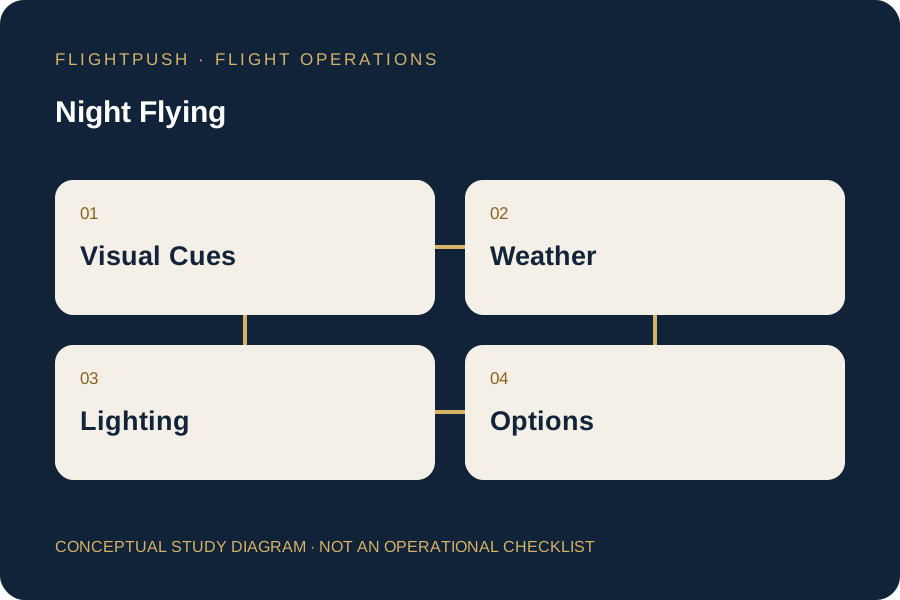
An airport can be easy to recognize by day and surprisingly difficult to identify at night. Terrain loses detail, unlighted areas hide obstacles, and bright lights can make distance difficult to judge. The airplane has not changed, but the information available through the windshield has.
Night preparation therefore involves more than adding a flashlight to a daytime plan. Route selection, weather, equipment, pilot readiness, and landing options all deserve another look through the limitations darkness creates.
Darkness Changes What You Can Infer
Good visibility does not guarantee a useful natural horizon. Over water or sparsely lighted terrain, a pilot can have a clear sky and still lack reliable outside attitude cues. A dark area may conceal rising terrain rather than represent an open, level space.
The AIM's guidance on vision in flight explains why visual limitations and illusions matter to pilots. Instrument proficiency and an appropriate instrument scan can become important even when the operation remains under visual flight rules.
Prepare for More Than One Definition of Night
Aviation rules use different time references for different purposes. The definition of night, position-light requirements, and passenger-carrying currency are related but not identical. Treating them as one sunset-to-sunrise rule can lead to mistakes.
For example, 14 CFR 91.209 addresses aircraft lighting requirements, while 14 CFR 61.57 specifies the takeoff-and-landing experience required to carry passengers during its defined nighttime window. Meeting a currency requirement does not establish that a pilot is proficient for a demanding route or unfamiliar airport.
Protect the Ability to See
Allow for adaptation to darkness and avoid unnecessary exposure to bright light. Arrange cockpit lighting so instruments and charts can be read without making the outside scene harder to see. A backup light should be accessible rather than buried beneath baggage.
Vision can also be affected by fatigue, hypoxia, illness, and medication. A pilot who feels adequate for an easy daytime flight may have less useful visual capacity and concentration when darkness, altitude, and workload combine.
Expect Misleading Approach Pictures
A runway's width, slope, lighting, and surrounding terrain can affect the perceived approach angle. An isolated lighted runway surrounded by darkness can make the approach especially deceptive. Bright lighting is not reliable evidence that the runway is closer than it is.
Use the published runway and airport information, appropriate visual glidepath aids when available, and the aircraft's instruments to cross-check the impression outside. If the approach becomes unstable or the picture cannot be reconciled, a go-around preserves options.
Evaluate Weather Beyond the Airport Lights
Clouds and precipitation can be harder to recognize before entering them. A route with good airport observations may still have obscured terrain or clouds between reporting stations. Do not infer a clear corridor merely because the next town's lights remain visible.
Check trends in temperature and dew point, forecasts, terrain-related obscuration, and the route's available observations. A delay that moves a flight into darkness can change the decision even if the numerical forecast remains the same.
Choose a Route With Usable Options
| Planning Concern | Night-Specific Question |
|---|---|
| Terrain | Can clearance be maintained without relying on ground detail? |
| Airports | Are suitable runways and their lighting available? |
| Equipment | Can essential information still be read after a failure? |
| Timing | Does a delay move the difficult portion into darkness? |
Confirm how lighting is activated and whether facilities will be available at arrival. A nearby airport is less useful as an option if its runway is closed or its required lighting is unavailable.
Plan the Cabin as Well as the Route
Brief passengers about lighting, movement, and the importance of avoiding distractions during critical phases. Secure loose items and identify essential switches before departure. Searching for something on a dark cockpit floor can create a substantial distraction.
Prepare for a display or electrical problem using the aircraft's actual procedures. The goal is not to rehearse every imagined failure, but to know what information and light remain available when the primary source disappears.
Keep the Decision Standard Honest
A successful daytime flight along a route is useful experience, but not proof that the same trip is appropriate at night. Evaluate the current combination of weather, terrain, equipment, pilot proficiency, and alternatives.
Night flying can be rewarding and orderly when those factors align. The professional habit is to account for what darkness removes from the picture, rather than assume that illuminated instruments and an airport beacon replace it.