Air Traffic Control
Understanding IFR Clearances From Departure to Landing
In Brief
An IFR clearance is an authorization that changes as the flight develops, not a fixed copy of the filed flight plan. This guide breaks a clearance into its elements and explains how readbacks and amendments work, how release times and void times differ from a takeoff clearance, and when 14 CFR 91.123 expects a pilot to speak up.
By FlightPushPublished October 22, 2026 5 min read
Contents
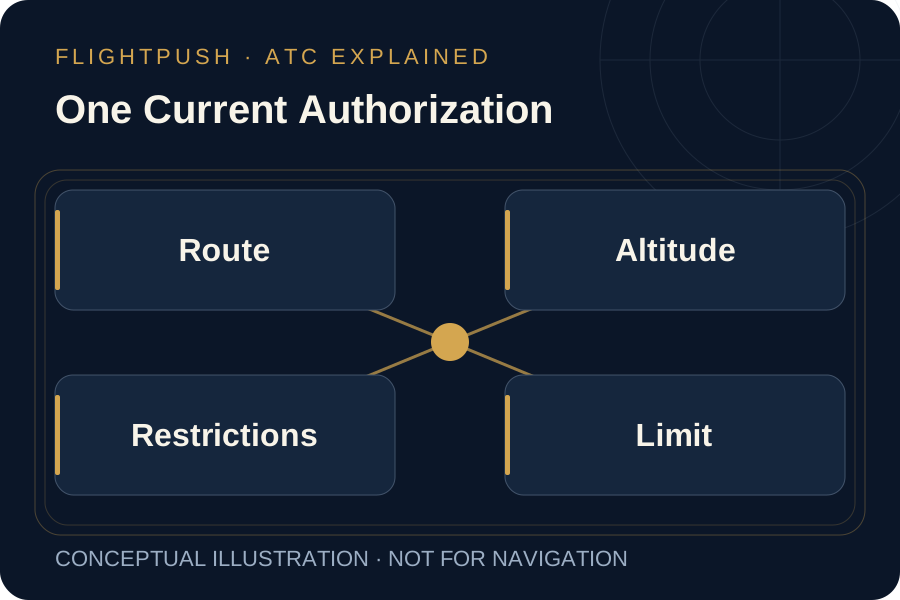
An IFR clearance is not simply a route read aloud, and it is not a promise that the whole flight will unfold without changes. It establishes an authorization under stated conditions. The pilot and ATC then use amendments, instructions, and reports to keep that authorization aligned with the operation as it develops.
Understanding clearances as a connected system makes familiar phrases easier to interpret. A filed flight plan, an expected altitude, a departure release, an approach clearance, and a landing clearance each have a role. Treating them as equivalent can leave an important permission or restriction misunderstood.
A Flight Plan and a Clearance Are Different
A flight plan communicates the proposed operation and information needed to support it. The clearance tells the pilot what has actually been authorized. The two may resemble each other closely, but they are not automatically identical.
The AIM's Clearance discussion explains the authorization in the context of traffic and known conditions. An aircraft can file a preferred route and still receive a different one because of traffic, airspace, weather, or other operational needs.
That distinction continues after departure. A preferred or expected next instruction is useful preparation, but the aircraft must be operated under the applicable clearance actually received rather than under a route that seemed likely earlier.
Identify the Elements of the Authorization
A clearance can contain a limit, route information, altitude instructions, and other applicable items. The exact elements depend on the operation. Their purpose is to leave the pilot with a coherent understanding of the authorized flight, not merely a collection of numbers to repeat.
The AIM's Clearance Items guidance provides the framework. Identifying the elements separately helps reveal an omission or misunderstanding before it affects the aircraft's movement.
| Element | The Understanding It Supports |
|---|---|
| Clearance limit | The point to which the aircraft is cleared under that authorization |
| Route | The path the aircraft is authorized to follow |
| Altitude information | The vertical instructions and limits that apply |
| Additional instructions | Other requirements that govern the particular clearance |
A clearance limit is not automatically permission to land, and an altitude expected later is not automatically an altitude that can be selected now. Each element must be read within the whole authorization.
Readback Is a Check, Not the End of the Task
A pilot's response gives the controller an opportunity to hear the interpretation. If a route, altitude, or restriction was misunderstood, the exchange can be corrected before the aircraft acts on it.
The pilot must also translate that understanding into the navigation and aircraft systems being used. Saying the correct altitude while selecting a different one does not preserve the clearance's effect. The same applies to choosing the wrong procedure with a similar name.
When an instruction is unclear or cannot be complied with, the uncertainty needs to be communicated. Guessing may produce a confident-sounding readback while leaving the pilot and controller with different expectations.
Amendments Change Specific Parts
A controller may amend a route, altitude, speed, or other instruction during the flight. The pilot needs to identify what has been replaced and what remains in effect. Hearing one new element is not a reason to discard every other restriction.
For example, an assigned heading changes the immediate lateral task. It does not independently authorize a climb above the current limit. A climb amendment likewise does not necessarily clear the aircraft direct to its destination.
This is where the route, altitude, and speed distinctions in a departure procedure become especially important. A published procedure can still supply requirements while a particular element is modified by ATC. The complete clearance, not an isolated remembered phrase, determines the current task.
Timing Instructions Have Separate Meanings
Departure-related timing can include a release restriction, a release time, or a clearance void time under the applicable procedures. These concepts affect when an aircraft may use the authorization, and what must happen if a required condition cannot be met.
They are not interchangeable with a takeoff clearance at an airport where one is required. Nor does the existence of an IFR clearance establish that the runway is available for an immediate departure.
Understanding the distinction is particularly important when departing without an operating control tower. The clearance and release process still have to be understood correctly even though the pilot is not receiving the same surface and runway instructions as at a towered airport.
Approaching the Destination Adds More Layers
An arrival route can position the aircraft for the terminal area without authorizing every descent or the approach itself. An approach clearance then has to be interpreted with the procedure, aircraft position, and applicable altitude instructions.
At an airport with an operating control tower, landing authorization is another part of the process. Being cleared for an instrument approach does not substitute for a landing clearance that is separately required.
A missed approach, go-around, or amended destination can change what happens next. The earlier plan remains useful context, but it cannot be treated as permission to invent an unissued route or altitude when the situation changes.
Compliance Includes Knowing When to Speak Up
14 CFR 91.123 addresses compliance with ATC clearances and instructions, including the circumstances described in the regulation. The operational lesson is to resolve ambiguity and communicate inability or an emergency rather than casually departing from an understood clearance.
A pilot's aircraft knowledge matters here. ATC may not know a particular performance limit, equipment problem, or cockpit condition unless the pilot supplies it. A prompt explanation can allow a different clearance or an appropriate response to be developed.
That communication is part of operating within a clearance system, not evidence that the pilot has failed to be cooperative. An instruction that cannot be safely or legally followed needs a clear response.
Keep a Current Mental Model
Across the flight, the pilot should be able to identify the authorized path, current altitude and restrictions, applicable timing, and next required action. Each amendment updates that model. Each handoff carries the flight into another part of the system without making the previous requirements disappear automatically.
For a student, this is more useful than memorizing a single clearance format. The format helps organize the information; the understanding is what keeps a changing flight aligned with the authorization actually in effect.