Air Traffic Control
How Pilots and ATC Communicate
In Brief
Radio communication exists to give the pilot and the controller the same picture of what the aircraft is authorized and expected to do. This guide explains working words such as contact, monitor, maintain, expect, and unable, why facility names change during a flight, how readbacks close the loop, and what happens when radio contact is lost.
By FlightPushPublished October 22, 2026 5 min read
Contents
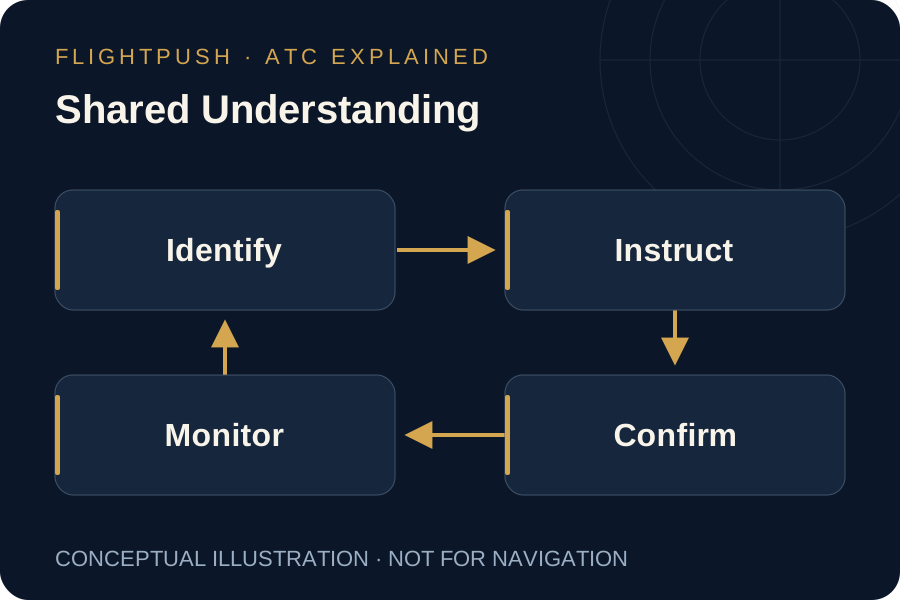
The radio is the part of air traffic control that everyone can hear. A pilot asks for a clearance, a controller assigns an altitude, and a short readback closes the exchange. Behind those few words is a larger task: two people need the same understanding of what an aircraft is authorized and expected to do.
That is why ATC communication is more than learning a collection of phrases. It is a system for identifying the participants, passing instructions, detecting misunderstandings, and restoring contact when the conversation breaks down. The wording becomes easier to understand when the purpose of each exchange is clear.
Start With the Shared Picture
A pilot knows the aircraft's condition, capability, and immediate cockpit workload. A controller knows the traffic and airspace information available at that position. Neither automatically has the other's complete picture. Communication connects those different views.
A useful transmission supplies the information needed for the next decision. Aircraft identification establishes who is speaking. Position, altitude, or intentions provide context when needed. The request or instruction then tells the listener what action is being discussed.
The AIM's Radio Communications guidance emphasizes understanding as well as brevity. Standard phraseology helps, but an unfamiliar problem still needs a clear explanation. A transmission that is short enough to sound polished but leaves the other person uncertain has not achieved its purpose.
Learn the Meaning of the Verb
Words such as contact, monitor, maintain, expect, and unable carry different meanings. They are not interchangeable ways to make a radio call sound more formal. A pilot who recognizes the callsign and the number but misses the verb can misunderstand the task.
| Wording | The Distinction That Matters |
|---|---|
| Contact | Establish communication with the named facility or function |
| Monitor | Listen on the specified frequency and await the expected call or instructions |
| Maintain | Continue with the assigned condition, such as an altitude |
| Expect | Anticipate something; an expectation alone is not the clearance to do it |
| Unable | State that an instruction or request cannot be complied with |
These meanings operate within the complete clearance and its context. A single word taken from a recording cannot establish everything that was previously issued to that aircraft. Good interpretation connects the latest exchange with the clearance already in effect.
Why Facility Names and Handoffs Differ
An airport tower and a regional approach-control facility need not share the same name. Departure control is a terminal function, while a Center provides en route services across a different operating environment. An airport's name therefore does not identify every controller an aircraft will talk to on its way out.
JO 7110.65's Radio Communications procedures describe transfers, including the conditions under which a location name or previously supplied departure frequency can be omitted. That explains why one instruction includes a regional name while another simply says “contact departure.”
A radio transfer also has coordination behind it. The receiving controller may already have information about the aircraft. The pilot's short instruction is the visible part of that process, not a complete account of who coordinated which responsibility.
Readbacks Close the Loop
The AIM's Pilot Responsibility upon Clearance Issuance guidance describes readbacks as mutual verification. A readback gives the controller an opportunity to hear what the pilot understood. It is especially valuable for information where a wrong number or missing restriction changes the aircraft's movement. The controller's listening and correction complete the process; the pilot speaking alone does not prove agreement.
Consider an illustrative departure exchange involving a heading and an altitude. If the pilot repeats only the frequency change at the end, the exchange gives less evidence that the maneuvering instructions were understood. The appropriate response needs to account for the actual instructions and applicable readback requirements.
A correct readback is still not a substitute for correct execution. Selecting the wrong altitude after saying the right number remains a problem. The cockpit task continues beyond the transmission, just as the controller's monitoring continues after issuing the instruction.
Timing and Frequency Discipline Matter
ATC frequencies are shared resources. Listening before transmitting reduces the chance of blocking another message. Thinking through a request before pressing the microphone helps keep the exchange useful, particularly when conditions are busy.
Silence needs interpretation too. A controller may be listening to another frequency or coordinating with another position. Repeated calls made too quickly can make the original problem harder to resolve. On the other hand, an immediate safety issue needs to be communicated as such rather than hidden inside a routine-sounding request.
Callsigns are part of this discipline. A familiar instruction heard nearby may belong to another aircraft. Similar-sounding callsigns deserve particular care, especially when several aircraft are receiving comparable headings, altitudes, or taxi instructions.
When the Conversation Breaks Down
A missed handoff, wrong radio selection, stuck microphone, or reception problem can leave an aircraft visible to ATC but unreachable on the expected frequency. Surveillance and voice communication are different capabilities. One functioning system does not prove that the other is working.
The Communications Failure procedures describe using appropriate available means to restore contact. Those can include emergency frequencies and other communications resources. A callsign heard on guard may therefore be a reconnect attempt; the frequency alone does not establish that the aircraft has declared an emergency.
A genuine distress or urgency condition needs clear information about the actual problem. Detailed lost-communications actions depend on the operation, aircraft, and applicable rules. The broader lesson is that restoring mutual understanding matters more than preserving the appearance of a normal conversation.
Communication Is an Ongoing Check
Across a flight, the same pattern repeats: establish identity and context, exchange the needed instruction or request, confirm understanding, and monitor what happens next. Clearances change, facilities change, and the traffic picture changes with them.
For a student, this makes the radio less mysterious. The goal is not to sound like a recording of an experienced pilot. It is to leave the pilot and controller with the same usable understanding, and to speak up when that understanding is incomplete.