Air Traffic Control
How ATC Manages Departures
In Brief
A departure is a chain: the clearance, the runway, the departure procedure, the climb, and the handoff to the next controller. The article explains how SIDs work, the difference between a climb-via clearance and climb and maintain, why runway timing matters, and why an aircraft can wait on a constraint far beyond the airport.
By FlightPushPublished October 22, 2026 5 min read
Contents
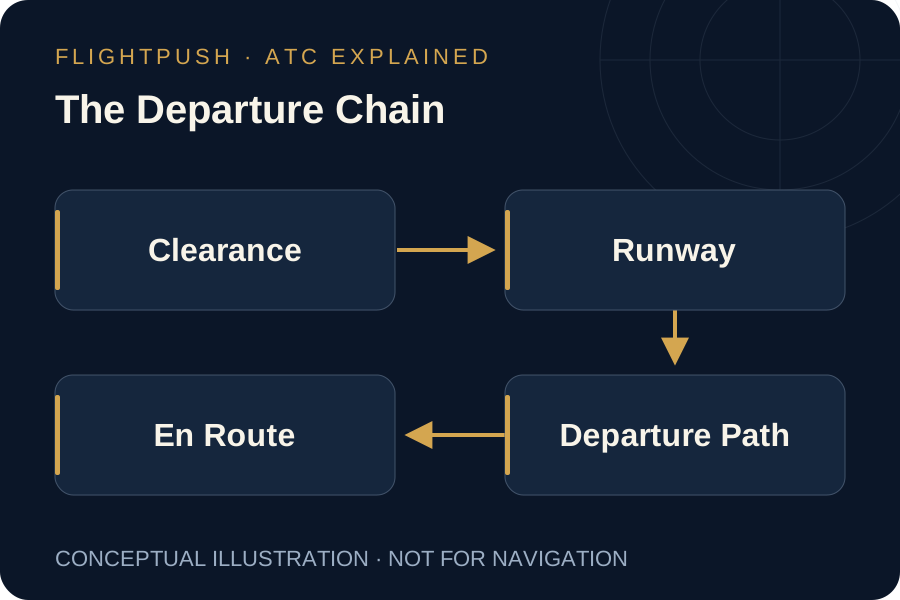
A departure begins before the takeoff clearance and continues well beyond the airport boundary. The airplane must leave the surface, follow an authorized path, climb through changing traffic, and join a route that the next controller can accept. The runway is only the first visible piece of that process.
Understanding departures as a connected sequence explains many familiar questions: why an aircraft waits at the runway, why one flight receives a heading while another follows a SID, why climb instructions differ, and why a departure can be delayed when the sky ahead looks empty.
The Clearance Establishes the Starting Plan
An IFR departure clearance defines important parts of the authorized flight, including route and altitude information. It may also contain instructions that apply only to the initial part of the departure. Expected later instructions help the crew prepare but do not replace the clearance currently in effect.
The pilot needs the complete applicable information before using it: the departure procedure, runway, navigation capability, altitude restrictions, and aircraft performance. A clearance can organize traffic without establishing that a particular airplane can meet every published climb requirement under the actual conditions.
The AIM's Instrument Departure Procedures guidance explains the roles of departure procedures, obstacle clearance, and ATC instructions. This is the foundation for understanding a SID as a published procedure rather than simply the name of a preferred exit route.
A SID Connects Several Requirements
A standard instrument departure can organize lateral navigation, altitude restrictions, speed restrictions, and the connection to the en route system. Its value is that many elements can be described in advance and communicated efficiently.
Different SIDs do not all work the same way. Some include published navigation to follow; others contain radar-vector segments. Runway transitions and route transitions can change which parts apply. A pilot cannot safely substitute a remembered procedure with a similar name for the chart and clearance actually issued.
| Departure Element | The Question It Answers |
|---|---|
| Runway and initial instructions | How does the departure begin? |
| Lateral path | Where is the aircraft authorized to go? |
| Altitude and speed restrictions | How must it fit the vertical and traffic plan? |
| Transition or onward route | How does it join the rest of the flight? |
These elements are related, but one does not erase another merely because it was mentioned most recently. A new heading does not independently authorize a new altitude, and an altitude amendment does not automatically create a direct route to the destination.
Climb-Via Clearances and Climb and Maintain
A climb-via clearance incorporates the applicable published lateral path and associated altitude and speed restrictions. The aircraft must also respect the applicable top altitude. That is different from treating the filed cruising altitude as an immediate permission to climb there.
The AIM also illustrates a SID with an assigned “climb and maintain” altitude. In that example, the airplane follows the lateral path and published speed restrictions while climbing without the SID's intermediate altitude restrictions to the assigned altitude. Separately issued restrictions and the complete clearance still matter.
The practical habit is to identify what changed, what remains, and where the climb must stop. High-performance or military climb requests can involve additional local procedures and coordination. Aircraft capability does not create a universal unrestricted-climb authorization.
The Runway Must Be Available at the Right Time
The tower is working with departures, arrivals, runway crossings, wake-turbulence requirements, and the runway configuration in use. A gap that looks sufficient from a holding position may not meet the applicable requirements or fit the next movement.
JO 7110.65's Same Runway Separation procedures describe part of the controller's framework. The relevant criteria depend on the operation; an observer should not infer one universal spacing rule from a few consecutive departures.
A takeoff clearance is therefore a timing decision within a larger plan. Line up and wait, an IFR route clearance, and a takeoff clearance authorize different things. The aircraft being ready to leave does not mean all the conditions for releasing it have aligned.
Departure Control Builds the Next Part of the Flight
After takeoff, departure control helps fit the aircraft into the terminal traffic environment. Its work can include identification, headings, altitude instructions, and coordination with the next sector or facility. The AIM's Departure Control discussion explains that role.
A vector can provide separation, organize a flow, or connect the airplane with an appropriate route segment. The short radio instruction does not reveal every arrival crossing above, neighboring departure stream, or receiving-sector constraint that influenced it.
A frequency handoff then moves the voice conversation onward. The aircraft may still be climbing, and the route may still require amendments. Departing the airport does not mean the airplane has left the coordination system behind.
Why an Empty-Looking Departure Can Still Wait
An aircraft can be held for a runway-related reason, a departure release, an assigned time, or a constraint farther along its route. Those are different problems with different solutions. The controller in view may be waiting for information or approval from elsewhere.
Consider a conceptual example: a runway is available, but the next sector cannot accept another aircraft on that exit at the desired time. Launching immediately could move a manageable ground delay into a more difficult airborne problem. The absence of nearby visible traffic does not establish unused downstream capacity.
That does not make every delay inevitable or every plan equally efficient. It explains why the reason for a departure wait cannot be read from the runway alone.
One Departure, Several Connected Decisions
A successful departure joins aircraft readiness, obstacle-clearance planning, runway availability, terminal sequencing, and en route acceptance. Each participant sees a different portion of that chain, and the radio exposes only some of the coordination.
For the pilot, the useful picture is the currently authorized route, restrictions, and next expected action. For the observer, it is the connection between an individual takeoff and the system that must receive the aircraft afterward.