Flight Planning
Aircraft Fuel Planning: Reserves, Reality, and Early Decisions
In Brief
The article separates fuel on board from usable fuel and explains the VFR reserves in 14 CFR 91.151 (30 minutes by day and 45 minutes at night for airplanes) and the IFR framework in 14 CFR 91.167. It covers budgeting fuel for every phase of flight, comparing planned and actual burn early, and setting decision points before departure. It also explains why running out of fuel and fuel not reaching the engine are different problems.
By FlightPushPublished October 22, 2026 4 min read
Contents
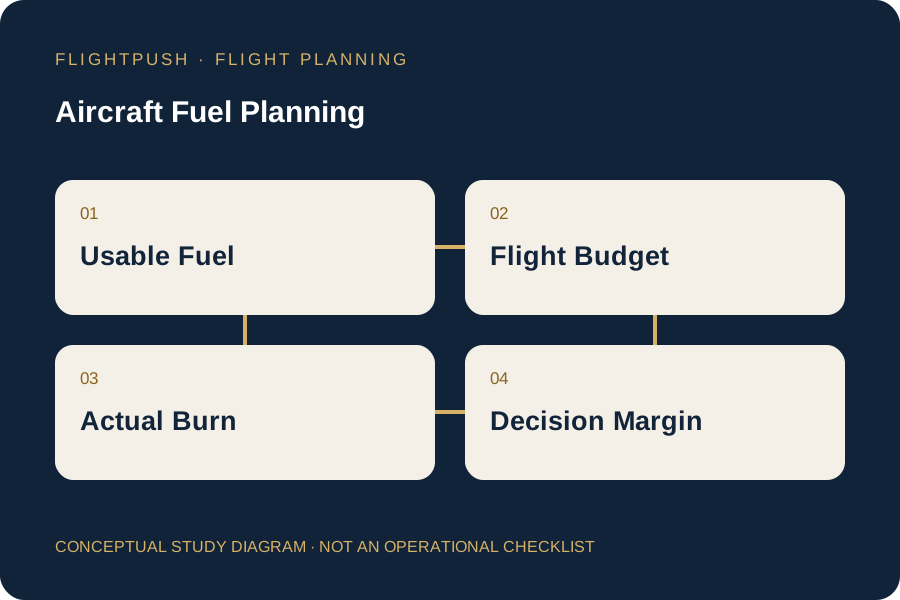
Fuel planning is often reduced to a calculation performed before departure. Divide fuel by consumption, compare endurance with flight time, and decide whether there is enough. The arithmetic matters, but the quality of its inputs and the timing of later decisions matter just as much.
Fuel quantity, usable fuel, consumption, winds, routing, and delays all contain uncertainty. A useful fuel plan makes those uncertainties visible and establishes when the pilot will act, rather than waiting for a gauge or an unexpectedly long leg to force the issue.
Separate Fuel on Board From Fuel You Can Use
The aircraft's total fuel capacity is not necessarily its usable fuel capacity. Unusable fuel, tank selection procedures, system limitations, and aircraft configuration affect what can reach the engine under approved operating conditions.
Determine the starting quantity using the procedures appropriate to the aircraft. Reconcile direct inspection, servicing information, gauges, and any fuel totalizer. A totalizer usually estimates fuel remaining from an entered starting quantity and measured flow; an incorrect starting entry can produce a reassuring but incorrect number.
Understand the Applicable Reserve
The rules differ with the aircraft and operation. Under 14 CFR 91.151, an airplane flight under VFR must begin with enough fuel, considering wind and forecast weather, to reach the first intended landing and then fly at normal cruising speed for at least 30 minutes by day or 45 minutes at night. The rotorcraft provision is different. Those figures should not be copied into every operation as a universal reserve policy.
For IFR operations covered by 14 CFR 91.167, the planning framework includes the intended airport, an alternate when required, and the specified additional endurance. Other operating rules and approved procedures can impose different requirements.
A regulatory minimum is not a recommendation to plan a routine arrival with the smallest possible margin. Practical reserve policy should account for uncertainty, available landing options, and the consequences of a diversion.
Budget for the Whole Flight
Taxi, runup, climb, cruise, descent, approach, a possible missed approach, and diversions do not all consume fuel at the cruise rate. Use the aircraft's applicable performance information rather than applying one familiar hourly number to everything.
Loading and altitude can change the profile. A heavily loaded aircraft may spend longer climbing. Stronger headwinds increase time along the ground track. A route change can add distance while an arrival delay adds time without moving much closer to landing.
Compare Planned and Actual Consumption Early
The first useful check should occur while there are still convenient places to land. Compare elapsed time, position, observed fuel flow, and remaining quantity with the plan. Investigate disagreement instead of automatically trusting the most optimistic instrument.
A groundspeed shortfall can erode endurance even when the engine consumes exactly the expected hourly amount. Conversely, a favorable groundspeed does not explain an unexpected fuel imbalance or a quantity indication that falls faster than expected.
Establish Decision Points Before Departure
| Decision | Why Making It Early Helps |
|---|---|
| Add a fuel stop | Preserves airport choices and reduces pressure |
| Change destination | Avoids spending the reserve on an unsuitable arrival |
| Recheck a discrepancy | Leaves time to identify an incorrect assumption |
| Ask for assistance | Lets others understand the developing constraint |
Decision points should be based on the aircraft, route, available airports, and personal reserve policy. A generic number copied from another pilot is unlikely to capture those conditions.
Fuel Supply and Fuel Delivery Are Different Problems
An engine can stop with fuel still aboard if that fuel is not reaching it. Tank selection, fuel system configuration, contamination, and mechanical problems are distinct from simply exhausting the usable supply.
That distinction explains why knowing the fuel system matters alongside endurance arithmetic. Follow the actual aircraft checklist for an abnormal indication or engine problem; an article cannot supply a universal tank-switching or restart sequence.
Treat a Deteriorating Margin as a Reason to Act
Pilots can become attached to the original destination, especially when it is close or passengers expect arrival. But fuel already consumed cannot be recovered by hoping for a shorter approach.
The strongest fuel plan pairs conservative preparation with repeated observation. It makes an unplanned stop easy to justify long before continuing becomes difficult to defend.