Aircraft Performance
Aircraft Weight and Balance: More Than Staying Under a Number
In Brief
Weight and balance is two checks, not one: total weight and the location of the center of gravity. This article explains weight, arm, and moment, how a forward or aft center of gravity changes the airplane, and why a load inside the envelope can still leave too little performance for the day. It closes with practical checks for catching bad inputs before trusting a calculator.
By FlightPushPublished October 22, 2026 4 min read
Contents
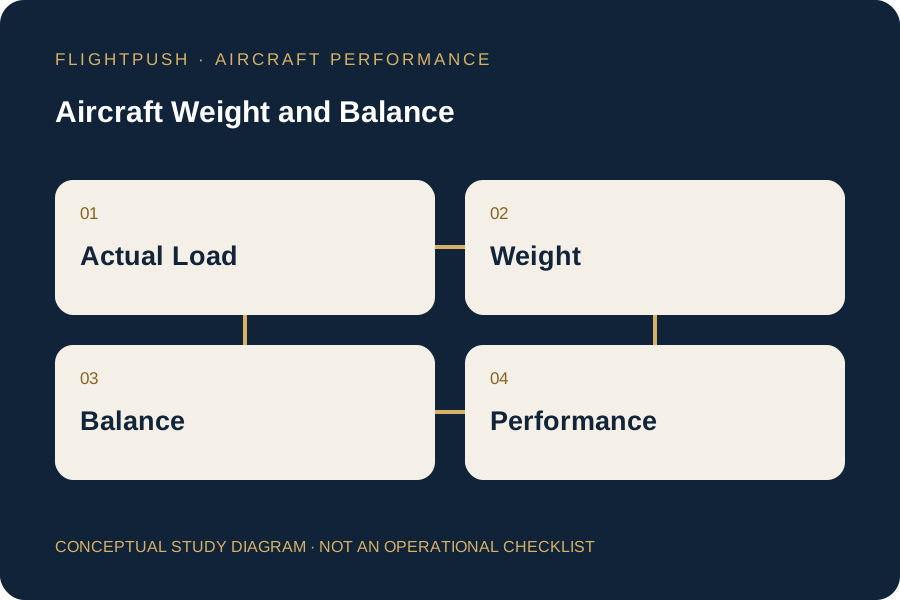
Two airplanes can have the same total weight and handle differently because the weight is distributed differently. Put passengers, baggage, and fuel in different places, and the aircraft's center of gravity changes even though a scale would report the same total.
That is why a loading decision requires both a weight check and a balance check. Neither one substitutes for the other, and neither tells the entire performance story. The loading calculation must describe the actual airplane that is about to fly.
Begin With the Aircraft's Current Records
An empty-weight figure from an old brochure is not the starting point for a particular airplane. Installed equipment, repairs, and modifications can change the aircraft's empty weight and moment. Use the current approved information and loading instructions applicable to that aircraft.
The operating limitations addressed by 14 CFR 91.9 include the applicable approved flight manual, markings, and placards. Generic examples explain the concepts; they cannot replace those aircraft-specific limits.
What Weight, Arm, and Moment Describe
Weight measures the load. Arm describes its distance from a reference datum. Moment is the product of weight and arm, with units and any scaling determined by the loading system being used. Add the relevant weights and moments, then use the approved method to locate the center of gravity.
The datum is a reference chosen for the aircraft, not necessarily the nose or a point a pilot can identify by looking at the cabin. Some loading forms use moment indexes to keep numbers manageable. Mixing indexed and unindexed numbers can invalidate a calculation that otherwise appears tidy.
Why Center of Gravity Changes the Airplane
A forward or aft shift affects the balance of forces needed for controlled flight. In a conventional airplane, a more forward center of gravity generally increases the balancing demand on the tail and can affect takeoff, landing, and stall characteristics. An excessively aft center of gravity can reduce longitudinal stability and make recovery from a stall more difficult.
The exact effects depend on the aircraft's design and configuration. Treat statements about typical airplanes as explanations, not as permission to extrapolate beyond the approved envelope.
Check the Envelope, Not Just Maximum Weight
A loading point can be below maximum gross weight and still fall outside the allowed center-of-gravity range. Some aircraft also have compartment limits, seating restrictions, maximum zero-fuel weight, or different limits for different operations.
| Loading Question | What It Protects |
|---|---|
| Is total weight within the applicable limit? | Structural and approved operating boundaries |
| Is center of gravity within the envelope? | Approved balance and handling characteristics |
| Are individual stations within their limits? | Compartment, seat, and local loading restrictions |
| Does performance suit today's conditions? | The practical ability to take off, climb, and land |
Passing the first three checks does not guarantee the last. A legally loaded airplane can still have inadequate performance for a hot, short, or obstacle-limited departure.
Consider How Loading Changes During Flight
Fuel burn changes weight and can move the center of gravity. The direction and amount depend on tank location and the aircraft's configuration. Check the relevant points in the flight using the approved loading method rather than assuming the takeoff calculation remains representative through landing.
A planned fuel stop also changes the loading decision. Fuel can trade against payload, but carrying less fuel creates a different route and reserve problem. These decisions belong together rather than in separate mental boxes.
Use Real Inputs and Check Plausibility
Passenger and baggage estimates can quietly accumulate error. Use appropriate, accurate inputs and account for items that are easy to overlook: headsets, tiedown equipment, tools, water, and baggage moved after the calculation.
Before accepting a calculator result, perform a reasonableness check. Does adding baggage aft move the result in the expected direction? Are fuel units correct? Does the selected aircraft profile match the registration and current equipment? A software tool cannot detect every mistaken premise.
Loading Is a Decision Before It Is a Calculation
The value of weight and balance work is the chance to change the load while the airplane is still on the ground. Move baggage, reduce payload, choose another aircraft, or change the plan when necessary.
The preflight requirements of 14 CFR 91.103 connect planning with the runway and performance information relevant to the flight. A complete loading decision joins that performance assessment with the aircraft's approved weight-and-balance envelope, rather than treating a green box in an app as the end of the process.