
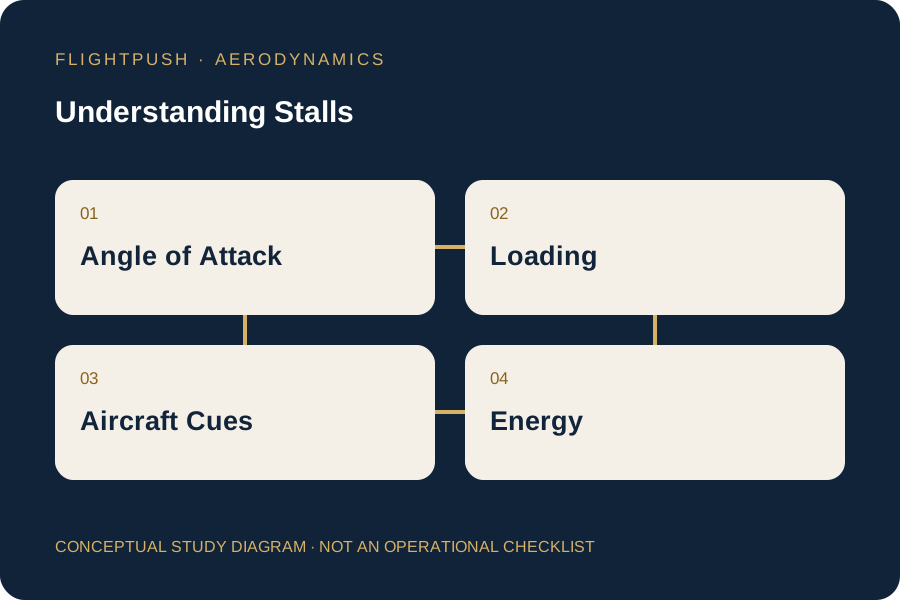
A stall is often introduced as something that happens when an airplane flies too slowly. That explanation is convenient for an early lesson, but incomplete. An airplane wing stalls when it exceeds its critical angle of attack. The indicated airspeed at which that happens depends on the conditions.
Understanding the distinction connects slow flight, steep turns, turbulence, approach handling, and upset prevention. It also explains why looking at one airspeed number cannot replace awareness of attitude, loading, coordination, and the aircraft's actual behavior.
Angle of Attack Is the Central Relationship
Angle of attack is the angle between the wing's chord line and the relative wind. It is not the same as pitch attitude. A nose-high attitude can occur with a modest angle of attack, and a wing can reach a critical angle of attack in an attitude that does not look like a textbook slow-flight demonstration.
As angle of attack increases, lift increases up to the relevant maximum for the wing's configuration and condition. Beyond the critical angle, airflow separation produces the stall. The pilot's task in a stall is therefore not simply to make the airspeed indication larger; the wing's excessive angle of attack must be reduced.
The Pilot's Handbook of Aeronautical Knowledge develops the aerodynamic relationships behind this behavior. The aircraft's approved procedures govern how those principles are applied in a particular airplane.
Why Published Stall Speeds Have Conditions
A handbook stall speed is associated with specified conditions such as weight, configuration, and loading. Change those conditions and the speed associated with the critical angle can change.
Increasing weight raises the lift required for the same flight condition. Increasing load factor also raises the demand on the wing. In a coordinated, level turn, maintaining altitude requires more total lift as bank increases, so the airplane can stall at a higher indicated airspeed than in unaccelerated level flight.
That statement does not mean bank angle alone creates a fixed stall speed. A descending or unloaded maneuver is a different condition. The important relationship is the load carried by the wing, not a memorized bank-angle threshold divorced from the maneuver.
Energy and Angle of Attack Are Related but Different
An airplane's energy includes its motion and height. A pilot can be slow and high, fast and low, or in another combination, and each situation offers different recovery options. Adding power may help manage energy, but it does not eliminate the need to reduce an excessive angle of attack.
Near the ground, the available height limits the room for recovery. That makes early recognition and avoiding excessive loading particularly important during takeoff, approach, go-arounds, and maneuvering near an airport.
Recognize the Aircraft's Own Cues
Depending on the airplane and conditions, cues may include a warning system, buffet, changes in control feel, reduced control effectiveness, or an uncommanded roll or pitch change. An angle-of-attack indicator, when installed, is one source of information with its own limitations.
Do not assume every aircraft gives the same sequence or the same amount of warning. Configuration, contamination, turbulence, and abrupt control inputs can change what the pilot experiences.
Coordination Matters
A stalled wing and yaw can create the conditions for a spin. A common training concern is a poorly managed turn toward final, where a pilot tries to correct an overshoot using inappropriate control inputs while also increasing the wing's loading.
The safer decision may be to abandon the approach and reposition rather than force the airplane onto a desired path. This is a planning and judgment issue as well as a handling issue: leaving room for a go-around reduces the temptation to salvage an unstable situation.
Keep the Concepts Separate
| Concept | What It Tells the Pilot |
|---|---|
| Airspeed | One important indication, with context-dependent stall margins |
| Angle of attack | The wing's relationship to the relative wind |
| Load factor | How much aerodynamic loading the wing must support |
| Energy | The motion and height available for the developing maneuver |
No single row replaces the others. A coordinated scan of the aircraft's attitude, indications, flight path, and cues produces a more useful picture.
Apply Aircraft-Specific Training
Stall prevention and recovery require qualified instruction in an appropriate aircraft or training device. Generic text should not prescribe a universal control sequence or promise a particular height loss.
14 CFR 91.9 reinforces the role of approved operating limitations. The durable lesson is that a stall is an aerodynamic condition, not merely a low number on the instrument panel. Recognizing how loading and flight path change that condition is what turns the definition into useful understanding.