JO 7110.65 — Air Traffic Control
JO 7110.65 3-9-6
SAME RUNWAY SEPARATION
Separate a departing aircraft from a preceding departing or arriving aircraft using the same runway by ensuring that it does not begin takeoff roll until:
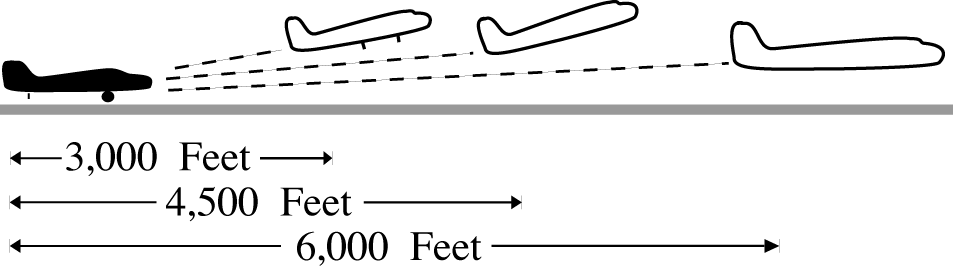
The other aircraft has departed and crossed the runway end or turned to avert any conflict. (See FIG 3-9-1.) If you can determine distances by reference to suitable landmarks, the other aircraft needs only be airborne if the following minimum distance exists between aircraft: (See FIG 3-9-2.) When only Category I aircraft are involved- 3,000 feet.
When a Category I aircraft is preceded by a Category II aircraft- 3,000 feet.
When either the succeeding or both are Category II aircraft- 4,500 feet.
When either is a Category III aircraft- 6,000 feet.
When the succeeding aircraft is a helicopter or powered‐lift aircraft, visual separation may be applied in lieu of using distance minima. FIG 3-9-1 Same Runway Separation
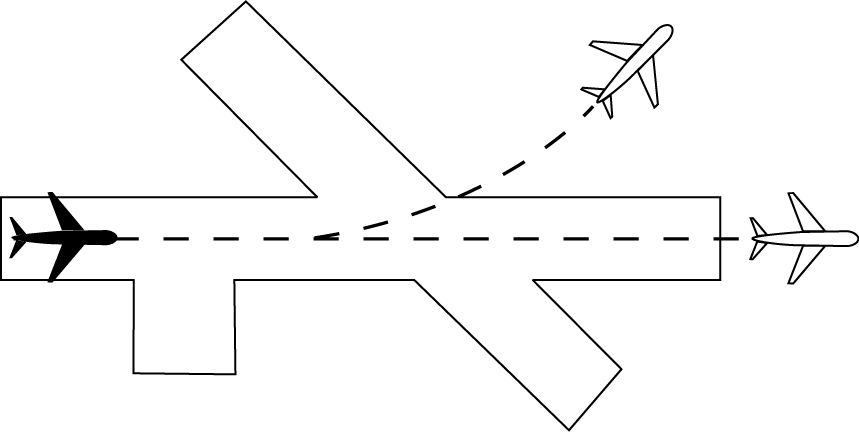
FIG 3-9-2 Same Runway Separation
NOTE-
Aircraft same runway separation (SRS) categories are specified in FAA Order JO 7360.1, Aircraft Type Designators and based upon the following definitions:
CATEGORY I− small single-engine propeller driven aircraft weighing 12,500 lbs. or less, and all helicopters.
CATEGORY II− small twin-engine propeller driven aircraft weighing 12,500 lbs. or less.
CATEGORY III− all other aircraft.
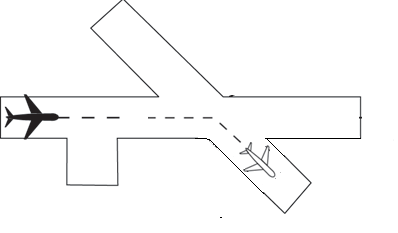
A preceding landing aircraft is clear of the runway. (See FIG 3-9-3.) FIG 3-9-3 Preceding Landing Aircraft Clear of Runway
REFERENCE-
P/CG Term- Clear of the Runway.
WAKE TURBULENCE APPLICATION
Do not issue clearances which imply or indicate approval of rolling takeoffs by super or heavy aircraft except as provided in paragraph 3-1-14 , Ground Operations When Volcanic Ash is Present.
Do not issue clearances to a small aircraft to line up and wait on the same runway behind a departing super or heavy aircraft to apply the necessary intervals. REFERENCE-
AC 90-23, Aircraft Wake Turbulence.
The minima in paragraph 5-5-4 , Minima, subparagraph g and TBL 5-5-1 , may be applied in lieu of the time interval requirements in subparagraphs f , g , and h . When paragraph 5-5-4 , TBL 5-5-1 , is applied, ensure that the appropriate radar separation exists at or prior to the time an aircraft becomes airborne. REFERENCE-
FAA Order JO 7210.3, Para 2–1–16, Authorization for Separation Services by Towers.
FAA Order JO 7210.3, Para 10–5–3, Functional Use of Certified Tower Radar Displays.
NOTE-
The pilot may request additional separation, but should make this request before taxiing on the runway.
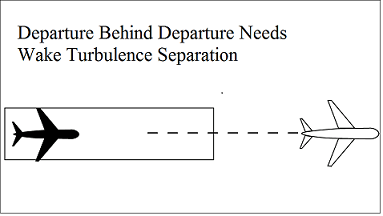
Takeoff clearance to the following aircraft should not be issued until the time interval has passed after the preceding aircraft begins takeoff roll.
Separate aircraft taking off from the same runway or a parallel runway separated by less than 2,500 feet (see FIG 3-9-4): Category B, C, D, E, F, G, H, or I aircraft behind Category A aircraft – 3 minutes .
Category B, C, D, E, F, G, H, or I aircraft behind Category B or D aircraft – 2 minutes .
Category E, F, G, H, or I aircraft behind Category C aircraft – 2 minutes . FIG 3-9-4 Same Runway Separation
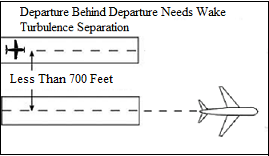
Separate a Category I aircraft behind a Category E aircraft by 2 minutes when departing: The same runway or a parallel runway separated by less than 700 feet. (See FIG 3-9-5 and FIG 3-9-6.) FIG 3-9-5 Same Runway Separation
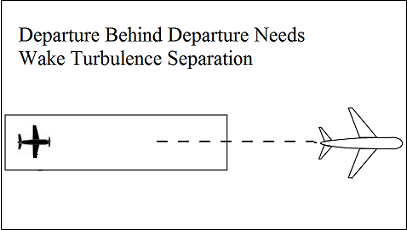
FIG 3-9-6 Parallel Runway Separated by Less than 700 Feet
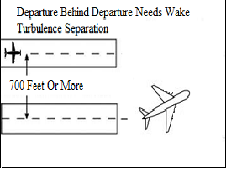
A parallel runway separated by 700 feet or more if projected flight paths will cross. (See FIG 3-9-7). FIG 3-9-7 Parallel Runway Separated by 700 Feet or More
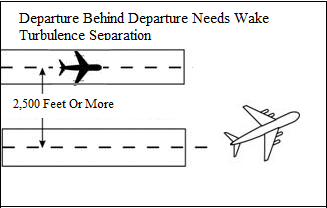
Separate aircraft departing from a parallel runway separated by 2,500 feet or more if projected flight paths will cross (See FIG 3-9-8): Category B, C, D, E, F, G, H, or I aircraft behind Category A aircraft – 3 minutes .
Category B, C, D, E, F, G, H, or I aircraft behind Category B or D aircraft – 2 minutes .
Category E, F, G, H, or I aircraft behind Category C aircraft – 2 minutes . FIG 3-9-8 Parallel Runways Separated by 2,500 feet or More
Separate aircraft when operating on a runway with a displaced landing threshold if projected flight paths will cross when either a departure follows an arrival or an arrival follows a departure by the following minima: Category B, C, D, E, F, G, H, or I aircraft behind Category A aircraft – 3 minutes .
Category B, C, D, E, F, G, H, or I aircraft behind Category B or D aircraft – 2 minutes .
Category E, F, G, H, or I aircraft behind Category C aircraft – 2 minutes .
Category I aircraft behind Category E aircraft – 2 minutes .
Separate an aircraft behind another aircraft that has departed or made a low/missed approach when utilizing opposite direction takeoffs or landings on the same or parallel runways separated by less than 2,500 feet by the following minima: Category B, C, D, E, F, G, H, or I aircraft behind Category A aircraft – 4 minutes .
Category B, C, D, E, F, G, H, or I aircraft behind Category B or D aircraft – 3 minutes .
Category E, F, G, H, or I aircraft behind Category C aircraft – 3 minutes .
Separate a Category I aircraft behind a Category E aircraft that has departed or made a low/missed approach by 3 minutes when utilizing opposite direction takeoffs or landings from: The same runway or a parallel runway separated by less than 700 feet.
A parallel runway separated by 700 feet or more if projected flight paths will cross.
Do not approve pilot requests to deviate from the required intervals contained in subparagraphs f through k . PHRASEOLOGY-
HOLD FOR WAKE TURBULENCE.
REFERENCE-
FAA Order JO 7110.65, Para 3-9-7 , Wake Turbulence Separation for Intersection Departures.
Separate a Category I aircraft behind a Category F or G aircraft that has departed or made a low/missed approach when utilizing opposite direction takeoffs on the same runway by 3 minutes unless a pilot has initiated a request to deviate from the time interval. In the latter case, issue a wake turbulence cautionary advisory before clearing the aircraft for takeoff. Controllers must not initiate or suggest a waiver of the time interval. NOTE-
A request for takeoff does not initiate a waiver request.
Inform aircraft when it is necessary to hold in order to provide the required time interval.
Retrieved from ecfr.gov on July 20, 2026.