JO 7110.65 — Air Traffic Control
JO 7110.65 3-7-6
PRECISION OBSTACLE FREE ZONE (POFZ) AND FINAL APPROACH OBSTACLE CLEARANCE SURFACES (OCS)
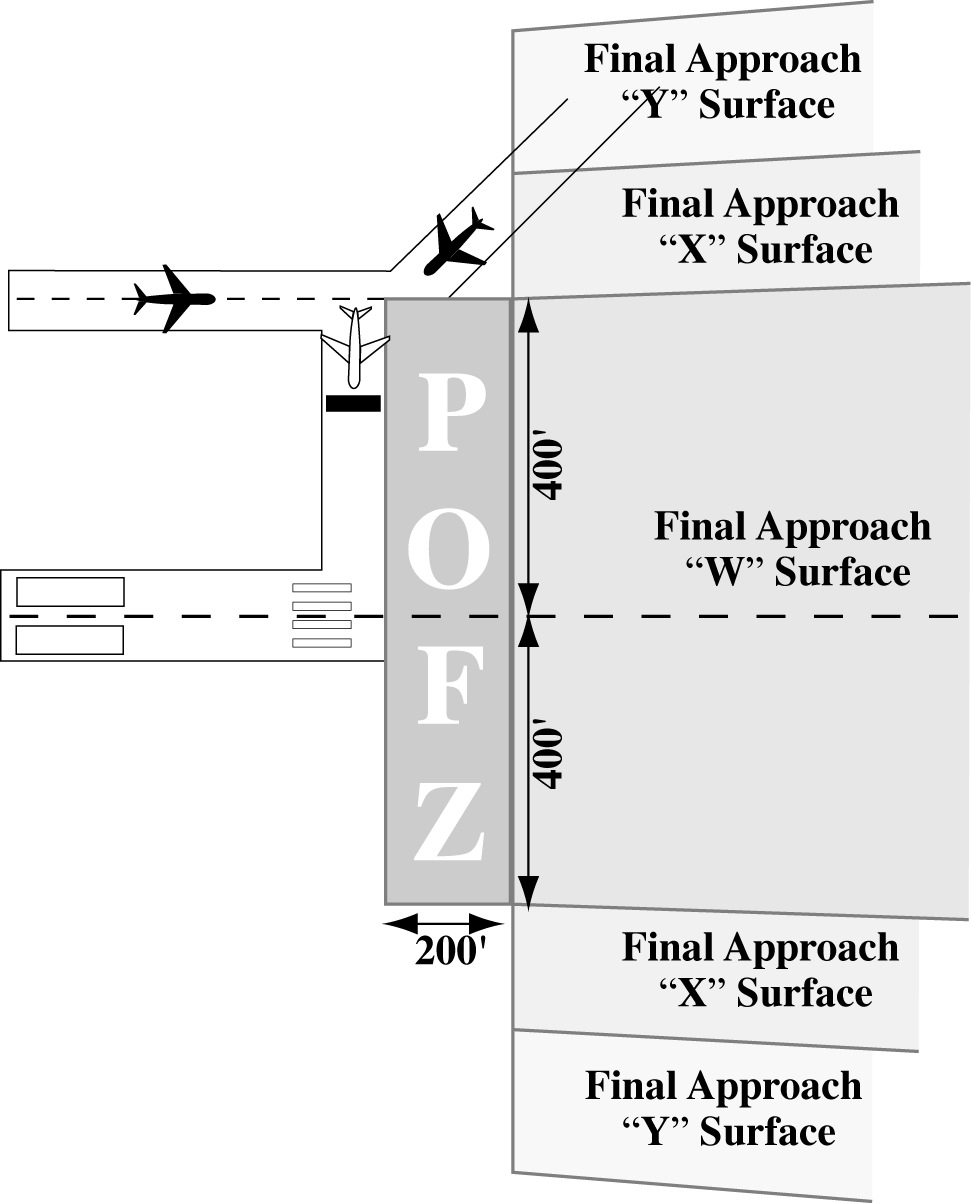
Ensure the POFZ is clear of traffic (aircraft or vehicles) when an aircraft on a vertically-guided final approach is within 2 miles of the runway threshold and the official weather observation indicates the ceiling is below 300 feet or visibility is less than 3/4 SM to protect aircraft executing a missed approach. NOTE-
Only horizontal surfaces (e.g., the wings) can penetrate the POFZ, but not the vertical surfaces (e.g., fuselage or tail). Three hundred feet (300) is used because ATC does not measure ceilings in fifty (50) foot increments.
Ensure the final approach OCS (e.g., ILS /LPV W, X, and Y surfaces) are clear of aircraft/vehicles when an aircraft on the vertically-guided approach is within 2 miles of the runway threshold and the official weather observation indicates the ceiling is below 800 feet or visibility is less than 2 SM to protect aircraft executing a missed approach. NOTE-
The POFZ and the close-in portion of the final approach obstacle clearance surfaces protect aircraft executing a missed approach.
Vehicles that are less than 10 feet in height, necessary for the maintenance of the airport and/or navigation facilities operating outside the movement area, are exempt.
If it is not possible to clear the POFZ or OCS prior to an aircraft reaching a point 2 miles from the runway threshold and the weather is less than described in subparagraph a or b above, issue traffic to the landing aircraft. NOTE-
The POFZ and/or OCS must be cleared as soon as practical.
PHRASEOLOGY-
(ACID), IN THE EVENT OF MISSED APPROACH (issue traffic).
TAXIING AIRCRAFT/VEHICLE LEFT/RIGHT OF RUNWAY.
EXAMPLE-
“United 623, in the event of missed approach, taxiing aircraft right of runway.”
“Delta 1058, in the event of missed approach, vehicle left of runway.”
REFERENCE-
FAA Order JO 7110.65, Para 3-1-6 , Traffic Information.
AC 150/5300-13, Airport Design.
FIG 3-7-1 Precision Obstacle Free Zone (POFZ)
Previous | Top | Next 7110.65 |
ATPUBS |
FAA |
Send your comments regarding this website.
Chapter 3. Airport Traffic Control - Terminal 7110.65BB
7110.65 by Chapter Number Chapter 0. General Information Chapter 1. General Chapter 2. General Control Chapter 3. Airport Traffic Control - Terminal Chapter 4. IFR Chapter 5. Radar Chapter 6. Nonradar Chapter 7. Visual Chapter 8. Offshore/Oceanic Procedures Chapter 9. Special Flights Chapter 10. Emergencies Chapter 11. Traffic Management Procedures Chapter 12. Canadian Airspace Procedures Chapter 13. Decision Support Tools Chapter 14. Data Link Communications Appendix A Appendix B
ATPUBS
JO 7110.65BB by Topic
General Information Explanation of Changes
General Introduction
Terms of Reference
General Control General
Flight Plans and Control Information
Flight Progress Strips
Radio and Interphone Communications
Route and NAVAID Description
Weather Information
Altimeter Settings
Runway Visibility Reporting- Terminal
Automatic Terminal Information Service Procedures
Team Position Responsibilities
Airport Traffic Control - Terminal General
Visual Signals
Airport Conditions
Airport Lighting
Runway Selection
Airport Surface Detection Procedures
Taxi and Ground Movement Procedures
Spacing and Sequencing
Departure Procedures and Separation
Arrival Procedures and Separation
Helicopter Operations
Sea Lane Operations
IFR NAVAID Use Limitations
Clearances
Departure Procedures
Route Assignment
Altitude Assignment and Verification
Holding Aircraft
Arrival Procedures
Approach Clearance Procedures
Radar General
Beacon/ADS-B Systems
Radar Identification
Transfer of Radar Identification
Radar Separation
Vectoring
Speed Adjustment
Radar Departures
Radar Arrivals
Radar Approaches- Terminal
Surveillance Approaches- Terminal
PAR Approaches- Terminal
Automation- En Route
Standard Terminal Automation Replacement System (STARS)-Terminal
Nonradar General
Initial Separation of Successive Departing Aircraft
Initial Separation of Departing and Arriving Aircraft
Longitudinal Separation
Lateral Separation
Vertical Separation
Timed Approaches
Visual General
Visual Separation
VFR‐On‐Top
Approaches
Special VFR (SVFR)
Basic Radar Service to VFR Aircraft- Terminal
Terminal Radar Service Area (TRSA)-Terminal
Class C Service- Terminal
Class B Service Area- Terminal
Offshore/Oceanic Procedures General
Coordination
Longitudinal Separation
Lateral Separation
Offshore/Oceanic Transition Procedures
Separation from Airspace Reservations
North Atlantic ICAO Region
Caribbean ICAO Region
Pacific ICAO Region
North American ICAO Region
Special Flights General
Special Operations
Special Use, ATC-Assigned Airspace, and Stationary ALTRVs
Fuel Dumping
Jettisoning of External Stores
Unmanned Free Balloons
Parachute Operations
Unidentified Anomalous Phenomena (UAP) Reports
Emergencies General
Emergency Assistance
Overdue Aircraft
Control Actions
Miscellaneous Operations
Oceanic Emergency Procedures
Ground Missile Emergencies
Traffic Management Procedures General
Canadian Airspace Procedures General Control
Decision Support Tools ERAM - En Route
ATOP - Oceanic
Data Link Communications Terminal Procedures for Issuing Automated Clearances
En Route Controller Pilot Data Link Communications (CPDLC) - Domestic
Advanced Technologies and Oceanic Procedures (ATOP) - Oceanic Controller Pilot Data Link Communications (CPDLC)
Appendix A
Appendix B
Airport Traffic Control - Terminal
Spacing and Sequencing
Chapter 3. Airport Traffic Control - Terminal
Section 8. Spacing and Sequencing
Retrieved from ecfr.gov on July 20, 2026.